
In 2022, Americans made 155 million emergency room visits. That figure comes from the CDC’s National Center for Health Statistics. A substantial share involved conditions a trained nurse could have managed over the phone. A structured assessment and a few targeted questions can be enough.
Often, a clear recommendation to stay home or schedule an appointment is all a patient needs.
The clinical discipline behind that decision is nurse triage. It is a protocol-driven process in which a registered nurse gathers patient history and applies standardized clinical tools. Every call ends with a directed recommendation for the right level of care.
The stakes on both sides are real. Unnecessary ER visits cost patients time, money, and exposure to a high-acuity environment they did not need. Missed urgent cases cost far more.
Organizations getting this right are not simply answering phones after hours. They are running a disciplined clinical function. It is built on verified protocols, staffed by licensed nurses who know exactly what to do with the information they collect.
Triage in Nursing: A Definition Rooted in Urgency
Triage in nursing is a structured clinical process. A registered nurse assesses a patient’s symptoms and determines how urgent the situation is. She then directs that patient to the right level of care. The destination may be self-care at home, a next-day appointment, or an immediate ER visit.
The word traces back to the French trier, meaning “to sort.” Military surgeons on 18th-century battlefields had to decide which wounded soldiers needed immediate care and which could wait. Modern nursing adopted both the term and the logic. Resources are finite; needs are not. Every clinical encounter begins with sorting.
Today, nurses apply standardized decision-making frameworks, including tools like the Emergency Severity Index, to stratify patients by acuity. They then route each patient to the appropriate care pathway. Research published on PubMed Central found that general nurses perform between 76.5% and 91% of ER triage assessments globally. That figure reflects just how foundational this skill is to the profession.
No algorithm replicates that clinical reasoning. When a patient’s stated complaint and visible distress tell two different stories, only a trained RN can reconcile them.
The core steps of a triage encounter follow a consistent pattern:
- Symptom gathering – collecting the patient’s presenting complaint, relevant history, and current medications
- Urgency stratification – applying a validated clinical framework to determine how quickly the patient needs care
- Care-pathway routing – directing the patient to self-care guidance, a scheduled appointment, urgent care, or the ER
- Documentation – recording the assessment and rationale to support continuity and accountability
- Follow-up flagging – identifying cases that warrant a callback or re-evaluation if symptoms change
For a closer look at how these decisions are structured in practice, the Nurse Triage Handbook offers a clinical reference built around real triage scenarios.
From Battlefield to Telephone: A Brief History
Nursing triage in America did not begin in a hospital. It began on the battlefield, where sorting the injured by survivability was a matter of life and death.
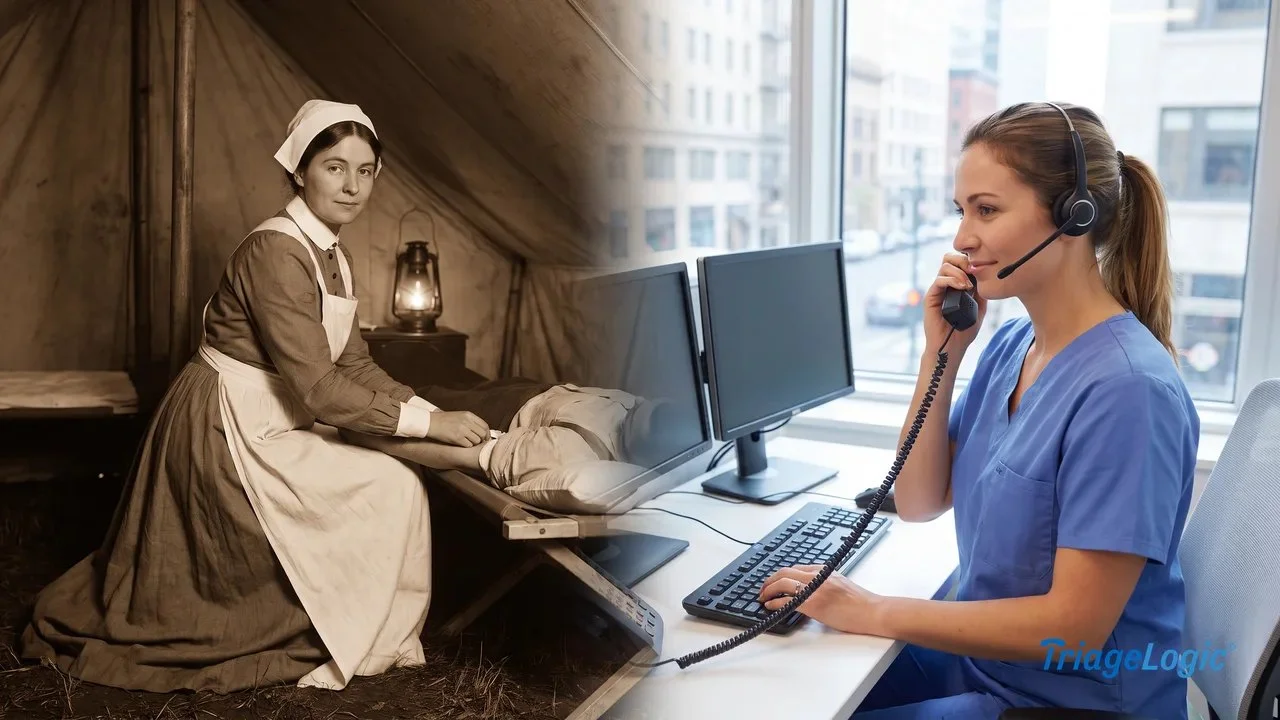
Dorothea Dix and Clara Barton did not invent the word “triage.” The French military had used it for decades. What they did was operationalize its meaning in American nursing practice. Working under fire, they made consequential clinical decisions: who could wait, who needed immediate intervention, who was beyond saving. That is precisely what triage in nursing means today.
Both World Wars pushed battlefield medicine forward fast. Those lessons followed nurses back into civilian practice. By the 1960s and 1970s, hospital emergency rooms were formalizing the RN triage role. Nurses gained explicit authority to assess patients at the door before a physician was available.
The scope was narrow at first, then expanded as evidence mounted. The 1980s and 1990s brought telephone triage into focus as its own clinical specialty. HMO growth drove part of that shift. Mounting pressure on ERs drove the rest.
Standardized tools helped enormously. Modern nurse triage protocols formalize the clinical judgment nurses built over a century of practice. A registered nurse can now conduct a clinically sound triage assessment for a patient hundreds of miles away. The technology is new; the instinct behind it is not.
The Protocols That Make Remote Triage Safe
A triage nurse’s clinical judgment depends on the framework supporting it. The gold standard across North America is the Schmitt-Thompson protocol set. This library contains a comprehensive set of peer-reviewed triage guidelines covering pediatric and adult conditions. It is widely used across telephone triage call centers on the continent and updated annually.
In practice, a nurse works through symptom-by-symptom decision trees. Follow-up questions continue until the picture is complete enough to assign a disposition. A generic answering service reads a script. The difference is consequential.
No automated tool can do what a trained nurse does. A trained nurse hears the pause before an answer. She senses that a caller is downplaying pain. She recognizes that the words say “mild” while the voice says something else entirely.
The protocol tells a nurse what to ask. Only a nurse can interpret what the caller cannot quite bring herself to say. AI cannot hear fear in a parent’s voice; technology supports the process, but clinical judgment drives every decision.
Our nurses follow physician-approved Schmitt-Thompson protocols on every call. Each triage decision rests on the same peer-reviewed evidence base regardless of shift, volume, or condition. If you are evaluating vendors on protocol standards, this is the marker to require. The vendor evaluation guide covers exactly what to ask any triage service about accreditation and clinical standards.
Key elements of a Schmitt-Thompson-based triage call:
- Symptom assessment using condition-specific decision trees, not generalized checklists
- Acuity routing that directs callers to self-care, a next-day appointment, urgent care, or the ER based on clinical criteria
- Follow-up questioning that surfaces details a caller may minimize or forget to mention
- Documentation of every decision point, creating a defensible clinical record of the call
- Annual protocol updates that incorporate current evidence, so nurses always work from current clinical standards
What Nurse Triage Actually Prevents
The measurable case for nurse triage rests on three pillars: fewer unnecessary ER visits, reduced burden on physicians and staff, and documented patient outcomes.
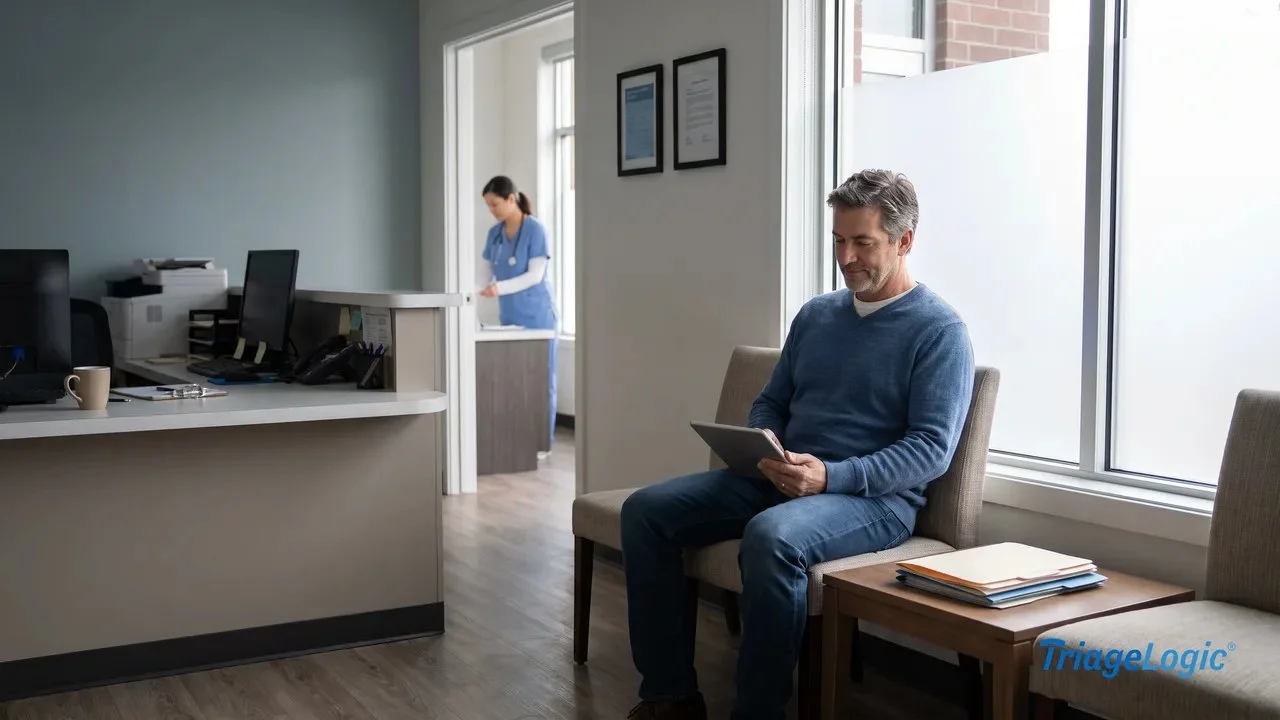
Start with ER overuse. According to the NCQA, up to 60% of all ER visits are non-urgent. The American Journal of Managed Care puts potentially avoidable visits somewhere between 13% and 37%. Nurse triage closes that gap before the patient drives to the hospital.
The burnout dimension is equally real. Physicians carrying on-call responsibilities absorb the full weight of every midnight question, every anxious parent, every ambiguous symptom. Outsourcing after-hours nurse triage to trained nurses removes that burden structurally.
A landmark BJGP systematic review found that at least 50% of after-hours calls resolve with telephone advice alone. Most callers never needed a physician to begin with. A separate HMO-based US study published on PubMed Central found that telephone nurse triage produced a 15% decrease in hospital ER use and an 11% decrease in outpatient physician services.
Approximately 1 in 6 triage calls we handle helps avoid an unnecessary ER visit. Our nurses respond in about 9 minutes on average. That is well within the URAC 30-minute callback standard. Download the Nurse Triage On Call guide to see how after-hours coverage is structured to reduce ER visits and protect physicians.
| Care Setting | Triage Outcome |
|---|---|
| Emergency room (non-urgent visit) | Avoidable with clinical phone assessment |
| Primary care visit | Right destination for most non-urgent needs |
| Telephone advice alone | Resolves 50%+ of after-hours calls (BJGP) |
How Remote Nurse Triage Works – and What to Look for in a Service
A registered nurse working remotely can perform a triage assessment that is clinically equivalent to an in-person intake. This holds true when the service runs on accredited standards and evidence-based protocols. A physician-led structure is also required.
Here is what a well-run remote triage call looks like. A patient calls after hours. An RN responds promptly. She gathers a complete symptom picture using Schmitt-Thompson clinical decision support tools.
She applies professional judgment to what she hears and documents the encounter. She then routes the patient to home care instructions, a next-day appointment, urgent care, or the ER. No generic script. No clerical workaround.
A licensed nurse making a clinical call, supported by physician-approved protocols.
Not every after-hours contact requires a nurse on the phone. For routine requests such as prescription refills, appointment questions, and care coordination follow-ups, there is a better path. Our automated medical message intake product, MedMessage Automate, works alongside nurse triage to capture patient requests around the clock. It uses physician-designed secure-text and digital-form pathways with structured clinical guardrails.
The tool shifts roughly 65% of routine front-desk calls to text and saves 3-7 minutes per message. Full EMR/EHR integration and HIPAA compliance are backed by SOC 2 Type II attestation. Structured intake handles administrative volume; licensed nurses handle clinical decisions.
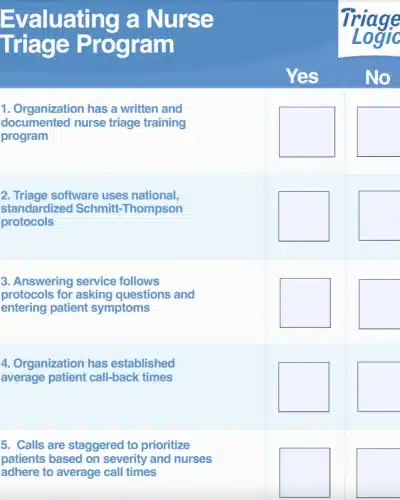
When evaluating a service, the due-diligence checklist matters more than marketing language. Look for:
- URAC Health Contact Center (HCC) accreditation – the relevant credential for nurse triage lines, distinct from URAC’s separate Telehealth accreditation program
- Schmitt-Thompson protocol use – which gives every triage decision a consistent, physician-approved clinical foundation
- Physician-led oversight – not just nurse supervision, a meaningful structural difference in accountability
- Documented response-time metrics – including average answer time and abandonment rate
- HIPAA compliance and SOC 2 Type II attestation for any digital or automated intake tools
We hold URAC HCC accreditation, are physician-led, and were founded in 2006. Our network spans more than 22,000 physicians covering over 42.5 million lives – a scale that supports both clinical rigor and consistent availability.
Frequently Asked Questions
What is triage in nursing, in plain terms?
Triage in nursing is a structured process. A registered nurse assesses a patient’s symptoms and determines how urgent the situation is. She then directs the patient to the right level of care. That destination may be self-care at home, a scheduled appointment, urgent care, or the emergency room.
How is telephone nurse triage different from a symptom-checker app?
A symptom-checker app follows a fixed algorithm with no clinical judgment. A triage nurse asks follow-up questions, listens for distress cues, applies physician-approved Schmitt-Thompson protocols, and makes a documented, accountable clinical recommendation – something no automated tool can replicate.
What protocols do telephone triage nurses use?
Most telephone triage services in North America use Schmitt-Thompson protocols. The set is peer-reviewed, covers a comprehensive range of clinical guidelines for adult and pediatric conditions, and is updated annually. It is widely used across triage call centers on the continent.
Does nurse triage actually reduce unnecessary ER visits?
Yes. A landmark HMO-based US study published on PubMed Central found a 15% decrease in ER use after implementing telephone nurse triage. Our own data shows that roughly one in six calls helps a patient avoid an unnecessary ER visit, with nurses typically responding in around 9 minutes.
What is URAC Health Contact Center accreditation and why does it matter for triage vendors?
URAC’s Health Contact Center accreditation is a specific program for organizations performing health triage or nurse hotline services. It sets defined performance thresholds – including calls back within 30 mins – and is a key quality marker when evaluating any outsourced triage vendor. It is a separate program from URAC’s Telehealth accreditation. Confirm which credential a vendor actually holds before signing a contract.
Closing Thoughts
The clinical discipline at the heart of nurse triage has not changed across more than a century of practice. Assess urgency. Route the patient to the right level of care. Document the outcome.
What has changed is the reach.
A well-run remote triage service is grounded in physician-approved Schmitt-Thompson protocols. Held to URAC Health Contact Center accreditation standards, it now covers millions of patient lives around the clock – without a gap in safety or documentation.
For organizations weighing an in-house build against an accredited partner, the evidence on clinical outcomes and cost points in the same direction. Our Nurse Triage Protocols guide walks through the operational and clinical specifics – or contact us directly to talk through your organization’s coverage needs.