
Most practice administrators treat their medical answering service as a utility. Something to have so calls do not go unanswered after the office closes. That framing costs them more than they realize. The answering service is where patient trust is built or broken, before any appointment, before any exam, often before the practice even knows the patient is considering leaving.
One of our physicians spent years in emergency medicine. He points out that the question patients ask most at 9 p.m. is not about refills or paperwork. It is simply: “Do I need to go to the emergency room?” How an organization answers that question shapes every interaction that follows.
Patients who reach a trained nurse get a clear, clinically grounded response. That matters. They are more likely to trust the practice the next morning, because someone actually helped them.
Those who reach a voicemail or a non-clinical operator make decisions based on fear. That fear drives real consequences: for the patient, and for the practice.
Patients Are Looking for Confidence, Not an Appointment
When a patient contacts a practice outside business hours, the most valuable thing on offer is not a scheduled slot. It is a clear, clinically grounded answer: What should I do next?
The scale of that anxiety is real. Four in ten adults say anxiety pushes them to delay care, according to Harvard Health Publishing. When patients cannot reach someone with the clinical knowledge to offer a grounded next step, some overreact and head to the ER. Others wait too long.
Neither outcome serves the patient, and neither serves the practice. For practice administrators, this reframes what after-hours coverage actually does. A medical answering service that connects callers to a registered nurse is not a convenience add-on; it sets the clinical and experiential trajectory of the entire patient relationship. A patient who gets a confident, accurate answer at 10 p.m. is far less likely to show up at the ER by midnight.
What Happens When That Call Goes Unanswered
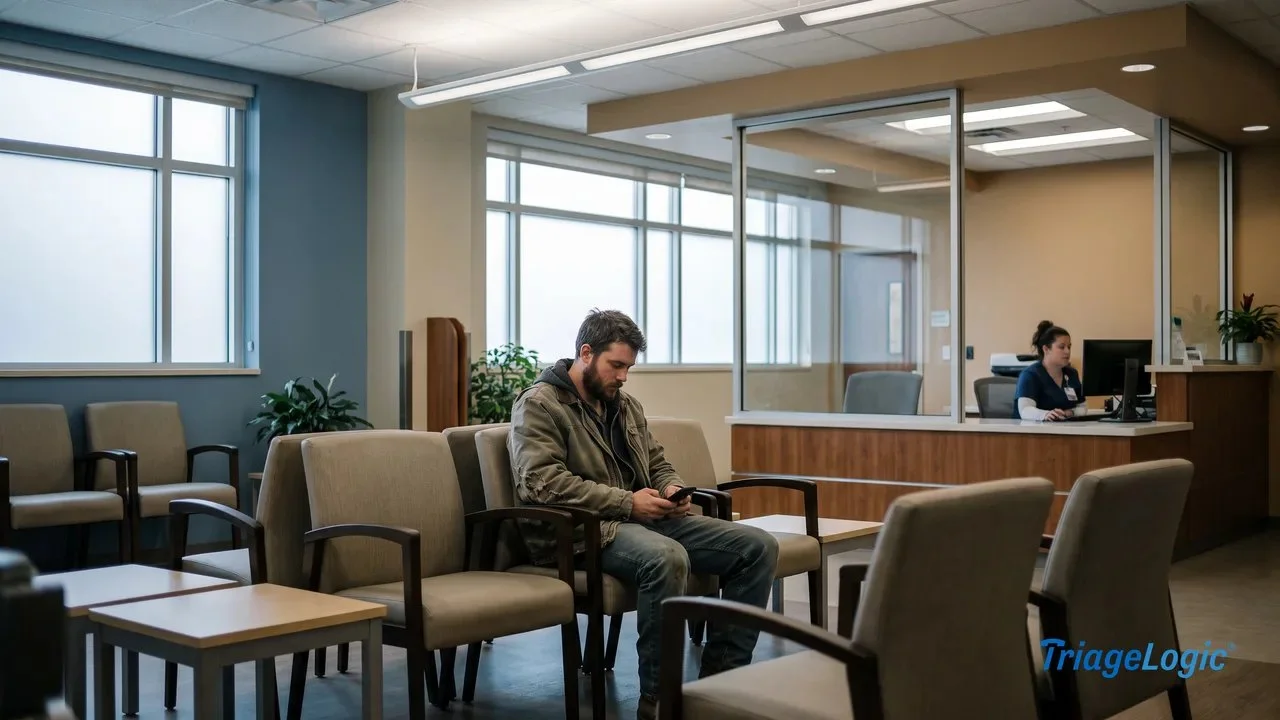
Patients who cannot reach a knowledgeable clinical voice default to their next available option: usually the emergency room. That decision is driven by fear, not medical need. Georgia APCD data estimated that 40% of ER visits in 2024 were avoidable, representing $716 million in unnecessary costs. When a medical answering service routes a caller to a voicemail box or a non-clinical operator, that caller does not wait until morning.
The downstream effects extend beyond one visit. According to HIT Consultant, 66% of patients said poor communication would lead them to switch providers in 2024, up from 51% in 2023. Research published in PubMed Central found that provider switching can reduce practice revenue by up to 10%. A single unanswered call rarely stays a single unanswered call; it becomes a pattern that patients remember and act on.
Consider what an unguided after-hours call actually costs:
- An unnecessary ER visit that a triage nurse could have prevented with a ten-minute call
- A patient who switches practices after one communication failure, taking their panel with them
- Clinical staff fielding calls without protocol support, adding burnout risk alongside clinical risk
- Compounding attrition that can reduce practice revenue by up to 10%
Read how structured nurse triage on call reduces unnecessary ER visits to see the mechanics behind that exposure and what it means at scale.
What a Clinical-Grade Medical Answering Service Does Differently
A nurse triage line running on physician-approved protocols is structurally different from a generic answering service. It is also different from an automated symptom tool. A message-taking service records a complaint and routes it. A registered nurse assesses it, and that difference shows up in patient outcomes.
The foundation of that assessment matters. Our nurses follow Schmitt-Thompson clinical protocols: evidence-based guidelines peer-reviewed annually and used to handle more than 25 million calls each year. A PubMed-indexed study of an academic pediatric practice found that a nurse triage line handled 70% of after-hours calls without physician involvement. At least 50% of after-hours calls are fully resolved by telephone advice alone, with no in-person visit required, according to the British Journal of General Practice.
That rigor has measurable effects. A symptom checker reads typed text. A registered nurse hears something else entirely: the pace of a caller’s speech, the catch in a parent’s voice, the moment someone hesitates before answering a follow-up question. As our physician author observed, “Reassurance (when it’s grounded in sound clinical judgment) is also a meaningful form of patient care.” No form or dropdown menu can replicate that.
Our operation reflects that standard in concrete terms:
- Our nurses return calls in about 9 minutes on average, well inside the URAC Health Contact Center 30-minute benchmark.
- We hold URAC Health Contact Center (HCC) accreditation, one of the more demanding quality standards a medical answering service can carry.
- Our physician-led network covers more than 42.5 million lives across more than 22,000 physicians, with every call handled by a registered nurse following physician-approved Schmitt-Thompson protocols.
- Roughly 1 in 6 of our triage calls helps a patient avoid an unnecessary ER visit. That figure reflects both clinical accuracy and the trust callers place in what they hear.
How Digital Front Door Closes the Gap Between the First Call and the Right Care
Our Digital Front Door pairs MedMessage Automate’s structured text-based intake with Nurse Triage On Call’s registered nurses. It is a simple idea with significant operational consequences. Every patient request, clinical or administrative, reaches the right person the first time. Fewer handoffs and less hold time mean no request falls through the cracks.
When a patient calls the practice’s existing number, they receive a secure text link with no app to download. From there, intake branches automatically. Administrative requests route to practice staff. Clinical requests and refills go to nurses, using whichever nurse staffing the practice has configured: ours, theirs, or both.
That separation alone changes the shape of a typical day for front-desk teams. The difference is immediate.
The safety record behind that intake process is worth noting. Our physician-developed, nurse-validated clinical intake protocols flagged 100% of patients who needed 911. They also flagged 99.4% of patients who needed the ER as urgent.
Over 95% of patients who use MedMessage Automate say they would use it again. Patients opt into text because it removes hold time. Clinical accuracy stays high because a person handles every request using fixed, auditable protocols. There is no generative AI and no autonomous decision-making involved.
Documented results across Digital Front Door implementations (based on historical TriageLogic customer data; results vary by organization, staffing, workflow, and implementation):
- Up to 75% reduction in front-desk calls
- Up to 50% less clinical phone time for nursing staff
- 5 to 10 minutes saved per patient interaction on average
- No setup fee, with a 30-day performance guarantee: if call volume does not drop, the practice cancels by email with no penalty
Consider a 25-physician practice handling 5,000 requests by text each month. That volume translates to 500 hours of staff capacity returned and $12,500 in monthly staff-time value. Under our modeled assumptions, the net annual benefit reaches $75,000.
For practices weighing this alongside other options, evaluating a medical call center covers the questions worth asking any medical answering service before you sign. The operational structure matters, but so does the clinical foundation underneath it.
Frequently Asked Questions
What is the clinical difference between a nurse triage line and a generic medical answering service?
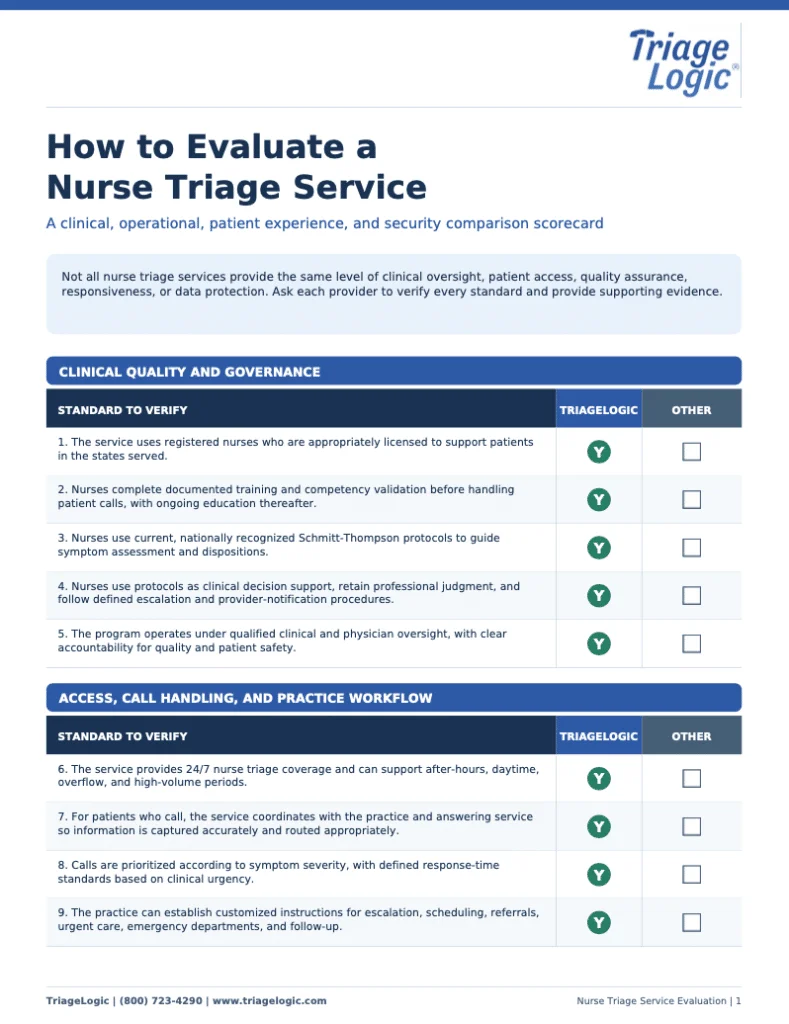
A nurse triage line staffs registered nurses who follow physician-approved protocols, such as Schmitt-Thompson, to assess symptom severity and direct patients to the right level of care. A generic answering service takes messages and routes calls without clinical assessment.
How quickly should a compliant after-hours nurse triage service return patient calls?
URAC Health Contact Center accreditation sets a 30-minute callback standard. Our nurses average roughly 9 minutes, well inside that threshold.
Can outsourced nurse triage reduce physician on-call burden?
Yes. A PubMed-indexed study of an academic pediatric practice found that a nurse triage line resolved 70% of after-hours calls without physician involvement. Our Nurse Triage On Call is designed to filter and resolve calls that do not require physician escalation.
What accreditation should a practice require from an outsourced triage vendor?
Look for URAC Health Contact Center (HCC) accreditation, which sets standards for callback time, abandonment rates, and clinical protocol use. Confirm that nurses operate on evidence-based, peer-reviewed protocols such as Schmitt-Thompson.
Why can’t patients just use a symptom checker or patient portal after hours?
Symptom checkers read typed text with no clinical judgment behind the response, and portal messages may not be monitored after hours. A registered nurse can hear urgency a text field cannot capture and can triage in real time rather than queuing a response for the next business day.
Patients have always wanted the same things: a timely answer, a credible voice, and confidence that they are doing the right thing. What shifted is the standard. After-hours access, structured intake, and a nurse who calls back in minutes are no longer differentiators. They are baseline expectations.
Practices that cannot meet them lose patients to those that can. That is a retention problem, a revenue problem, and, when a genuinely urgent call slips through, a safety problem.
Our Digital Front Door pairs MedMessage Automate with Nurse Triage On Call to cover every patient request from the first ring forward. The setup is straightforward: no setup fee, a 30-day performance guarantee, and onboarding that fits inside one month. See how Digital Front Door works and find out whether it fits your practice.
Sources
- TriageLogic physician essay: What Telemedicine Taught Me About Patient Expectations
- Harvard Health Publishing (2023)
- HIT Consultant (2024)
- British Journal of General Practice
- PubMed Central (2025)
- Georgia APCD (2024)