
Most clinicians assume triage is triage. Sort by urgency, route the patient, move on. That assumption costs healthcare organizations millions of dollars in unnecessary ER visits every year.
ER triage and telephone triage are two separate clinical frameworks. Each serves a different moment in the care continuum.
In the emergency room, nurses prioritize patients by acuity and resource need using a five-level algorithm. On the phone, a trained triage nurse works through evidence-based Schmitt-Thompson protocols. The goal is to determine urgency before a patient ever leaves home.
Organizations that understand both systems make smarter routing decisions. Those that treat them as interchangeable keep sending non-urgent callers through the most expensive door in healthcare.
Why Five Levels Beat Three
A three-level triage system leaves too much gray area. Research published in the Journal of Emergency Nursing found that switching to a five-level system cut Under-Triage rates from 28% to 12%. It also raised sensitivity from 58% to 68%. That is a measurable safety gain, not a theoretical one.
The ACEP/ENA Joint Task Force pushed the field toward five-level instruments because three buckets are not enough. A patient who needs rapid intervention can land in the same category as one who can safely wait. In a cardiac event or sepsis presentation, that ambiguity costs time. Time is the margin between recovery and irreversible harm.
The Emergency Severity Index emerged as the answer. According to Wikipedia, emergency physicians Richard Wuerz and David Eitel developed it in 1998. The Emergency Nurses Association now maintains it.
The ESI stratifies patients from Level 1 (immediate, life-threatening) to Level 5 (non-urgent, minimal resources needed). It factors in both acuity and anticipated resource use. Not every urgent case looks dramatic on arrival. Not every worried patient needs a bed.
According to NCQA, up to 60% of all ER visits are non-urgent and potentially avoidable. Without finer levels of triage, staff cannot efficiently redirect lower-acuity patients. Learn how evidence-based nurse triage protocols translate acuity levels into consistent clinical decisions.
The clinical stakes at each end of the spectrum:
- Under-Triage delays life-saving intervention for high-acuity patients. Consequences are often irreversible.
- Over-Triage pulls resources toward non-urgent cases and drives ER overcrowding that slows care for everyone.
- Five-level specificity gives clinicians a shared language. It reduces the subjectivity that makes three-level systems unreliable across different nurses and shifts.
- Resource prediction is built into the ESI. Level 4 and Level 5 patients are each expected to need one or zero resources. This helps staff route them toward lower-intensity settings rather than a full ER workup.
The ESI Scale in Practice
Every patient arriving at an emergency room receives one of five ESI levels. Nurses base that assignment on acuity and anticipated resource consumption, not symptoms alone. A patient in cardiac arrest and a patient with a medication question both walk through the same door. The ESI ensures they are never treated as equivalent problems.
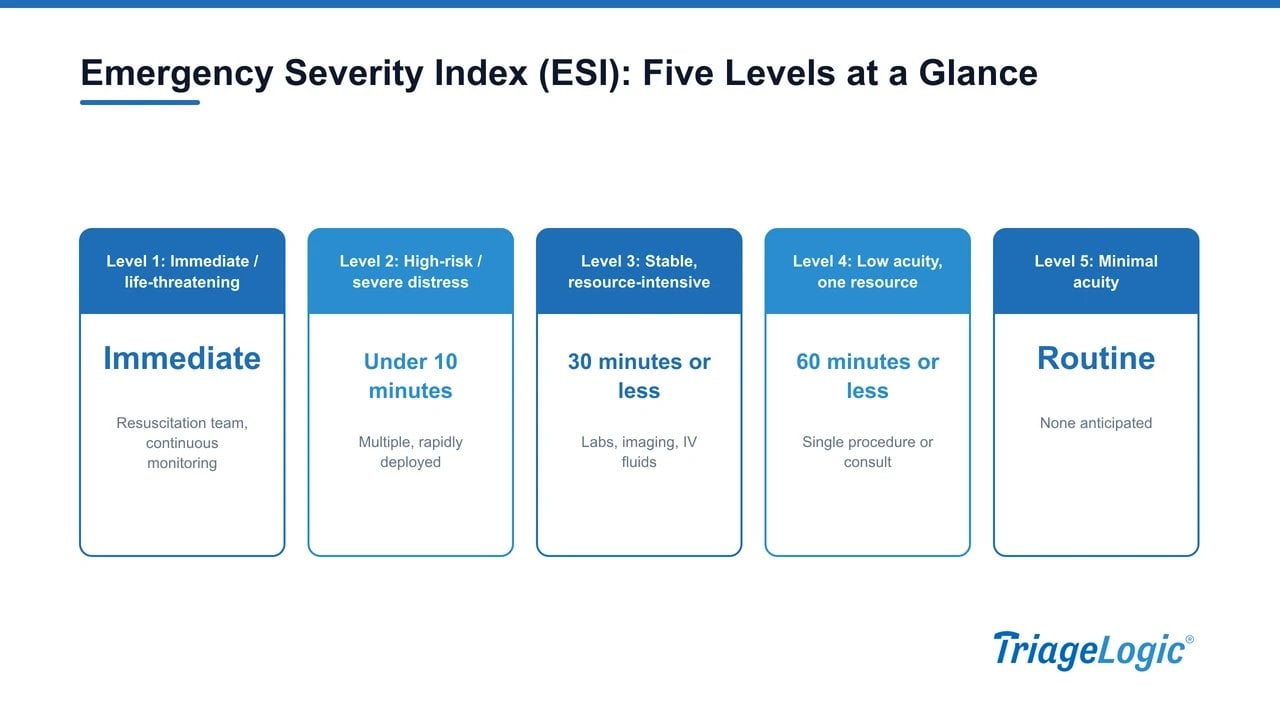
Immediate life-saving intervention defines Level 1. Think cardiac arrest, where every second without action narrows survival odds. High-risk presentations with severe distress define Level 2; chest pain with diaphoresis is a clear example. Level 3 is the workhorse of most ERs. It covers stable patients who still need multiple resources, like a person with abdominal pain requiring both labs and imaging. At Level 4, a single resource is involved, such as a laceration needing sutures. Level 5 requires no resources at all, such as a patient asking about a medication refill. See how patient symptom patterns map to acuity outcomes in TriageLogic call data.
| ESI Level | Acuity Descriptor | Typical Resources | Door-to-Physician Target |
|---|---|---|---|
| 1 | Immediate / life-threatening | Resuscitation team, continuous monitoring | Immediate |
| 2 | High-risk / severe distress | Multiple, rapidly deployed | Under 10 minutes |
| 3 | Stable, resource-intensive | Labs, imaging, IV fluids | 30 minutes or less |
| 4 | Low acuity, one resource | Single procedure or consult | 60 minutes or less |
| 5 | Minimal acuity | None anticipated | Routine |
Each row represents a distinct clinical decision point. It is the shared language that keeps a triage nurse and an attending physician aligned under pressure.
Telephone Triage: The Parallel System That Keeps Non-Urgent Patients Out of the ER
Telephone triage assigns urgency levels before a patient ever leaves home. It directs callers to the right care site based on described symptoms. Critically, it does not produce a diagnosis.

Think of it as a parallel acuity framework that runs upstream of the ER. Our nurses follow physician-approved Schmitt-Thompson protocols on every call. They sort callers into clear dispositions: call 911 now, go to the ER, see your doctor tomorrow, or manage at home with specific self-care guidance.
The contrast with ER triage is fundamental. An ER nurse has the patient physically present, vitals on the monitor, and visual cues in plain sight. A telephone triage nurse works through active listening, structured questioning, and clinical judgment alone. The American Academy of Ambulatory Care Nursing’s 16-standard telehealth framework defines what safe, high-quality telephone triage nursing looks like professionally. The bar is high.
No algorithm catches the pause before a caller answers a symptom question. No automated tool hears the fear underneath a parent’s measured tone. Technology supports the process, but clinical judgment drives every decision at these levels of triage.
Download the Nurse Triage On Call guide to see how after-hours telephone triage levels work in practice.
The Cost of Getting Acuity Wrong
Misassigning acuity in either direction carries a real price. Over-Triage sends non-urgent patients to the emergency room. The Annals of Emergency Dispatch and Response estimates this could reach $38 billion nationally in avoidable visits. Under-Triage risks patient harm that no cost figure adequately captures.
A VA study published in NIH National Library of Medicine (PMC) analyzed over one million calls to RN triage lines. It found that access to on-demand medical advice was associated with a 5.5% decline in subsequent ER visits. There was no change in hospital admissions or short-term mortality.
After-hours on-call burden is also a structural contributor to physician burnout, according to STAT News. A physician answering a personal cell phone at midnight cannot document the call or apply standardized protocols. That is not triage. That is improvised risk.
The organizational costs of inaction:
- Under-Triage: A patient with chest pain is told to call back in the morning, delaying potentially urgent care.
- Over-Triage: A child with a mild fever is sent to the ER, occupying a bed that structured nurse triage could have freed.
- Clinician burnout: Fragmented after-hours calls erode primary care sustainability without improving patient outcomes.
- Liability exposure: Informal advice given without documentation or standardized protocols leaves practices with no defensible record.
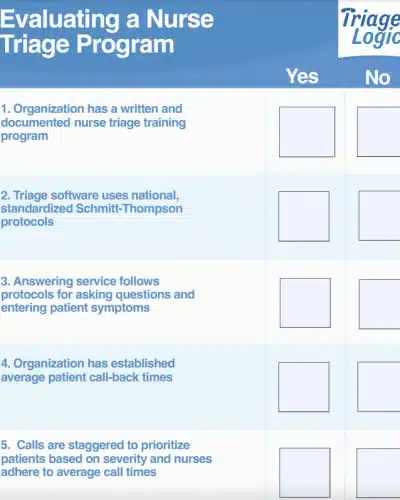
Use this checklist to evaluate whether your current call-handling model closes acuity gaps.
How We Apply Triage Levels in Real Time, at Scale
Our physician-led nurse triage service applies Schmitt-Thompson protocols on every call. We average 9 minutes, well inside the URAC Health Contact Center 30-minute callback standard. That speed matters because acuity does not wait.
Consider a caller who reports chest tightness at 11 p.m. A trained nurse works through the Schmitt-Thompson chest pain protocol and identifies high-risk features. That person is routed to the ER within minutes. The call is documented, defensible, and consistent regardless of which nurse answers. No algorithm reads hesitation in a voice. No algorithm catches an offhand mention of jaw pain that changes the clinical picture entirely.
That consistency scales across a network covering more than 42.5 million lives and more than 22,000 physicians. Approximately 1 in 6 triage calls helps avoid an unnecessary ER visit, directing patients toward care that matches their actual acuity.
For messages that arrive before a call is placed, MedMessage Automate captures and prioritizes patient requests before they reach a triage nurse. These physician-designed secure digital pathways run 24/7. They shift roughly 65% of routine front-desk calls to text and save 3 to 7 minutes per message. They also integrate with EMR/EHR systems. The platform carries SOC 2 Type II attestation alongside HIPAA compliance.
Nurses handle clinical judgment. Structured intake handles the rest.
What to Look for in a Triage Partner
A nurse triage vendor’s acuity framework is only as strong as its clinical oversight, protocol governance, and accreditation. Ask for specifics on all three before signing a contract.
URAC Health Contact Center (HCC) accreditation sets the floor for what “structured” actually means. It requires 24/7 licensed RN access, defined clinical guidelines, live answer within 30 seconds, and callbacks within 30 minutes. These are audited requirements, not aspirational targets. We hold URAC HCC accreditation as a physician-led organization founded in 2006.
Protocol governance matters just as much as response time. Our nurses follow physician-approved Schmitt-Thompson protocols, the field’s peer-reviewed standard for assigning levels of triage across acuity ranges. A study in the Annals of Emergency Dispatch and Response covering 3,976 cases found nearly $1.2 million in payments avoided and patient satisfaction of 91.2%.
The Nurse Triage Handbook covers performance benchmarks in detail. When evaluating any vendor, ask:
- Which clinical protocols govern disposition decisions? Schmitt-Thompson is the peer-reviewed standard; generic guidelines are not equivalent.
- How is nurse performance audited? Look for documented quality review, not self-reported compliance.
- What is the documented callback response time? Ask for average times, not just policy maximums.
- How are calls documented and integrated with your EMR? Gaps between the triage record and the clinical chart create risk.
- Who provides physician oversight? A physician-led structure changes accountability at every level of the process.
Frequently Asked Questions
What are the five levels of triage in the emergency room?
The ESI uses five distinct levels. Level 1 requires immediate life-saving intervention. Severe distress or high-risk presentations define Level 2. Level 3 applies to stable patients who still need multiple resources. A single resource distinguishes Level 4. Level 5 requires no resources at all. The ESI is the most widely adopted five-level triage instrument in U.S. emergency medicine.
How does telephone triage differ from emergency room triage?
ER triage sorts patients who are physically present by acuity and resource need. Telephone triage sorts callers remotely by urgency using structured protocols like Schmitt-Thompson. It routes them to the right care site before they travel anywhere. The two systems run in parallel and serve different access points in the care continuum.
What protocols do telephone triage nurses use to assign urgency levels?
Most telephone triage services follow Schmitt-Thompson clinical protocols, the most widely used evidence-based framework in the field. These protocols are peer-reviewed. They map caller descriptions to specific disposition recommendations ranging from “call 911 now” to “manage at home.”
What accreditation should I require from an outsourced nurse triage vendor?
URAC Health Contact Center (HCC) accreditation is the primary quality benchmark for outsourced nurse triage services. It requires 24/7 licensed RN access, defined clinical guidelines, and callbacks within 30 minutes. Ask vendors for current accreditation status, not just claimed compliance. Learn more at URAC’s Health Contact Center accreditation page.
What is the measurable impact of nurse triage on unnecessary ER visits?
A VA study published in NIH National Library of Medicine (PMC) of over one million RN triage calls found a 5.5% decline in subsequent ER visits. There was no increase in hospital admissions or short-term mortality. In our own call data, roughly one in six triage calls redirects a patient away from the ER. That is a consistent outcome of applying structured acuity levels on every call.
Closing Thoughts
Triage levels are not just a clinical taxonomy. They are the operational architecture that determines whether a patient waits in a crowded waiting room or reaches the right care through the right channel at the right time.
Organizations that build a structured, protocol-driven triage layer across every access point close the gap between clinical intent and actual outcome. That consistency does not happen by chance. It happens because the right clinician follows the right process on every call.
Our URAC Health Contact Center-accredited, physician-led nurses apply these levels to every call. They follow Schmitt-Thompson protocols and average a 9-minute callback time. To see what that looks like in practice, start with our nurse triage podcast conversation or connect with our team directly at our contact page to schedule a demo.