Hospitals are rethinking where care happens—and that’s changing everything about how patients get help.
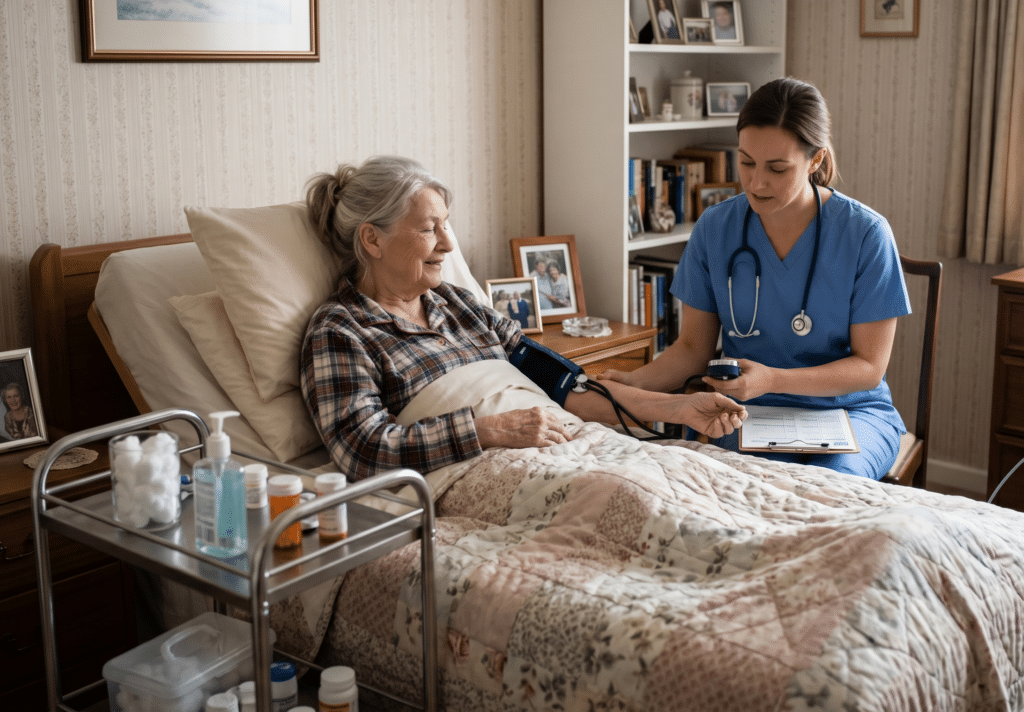
A growing number of health systems across the U.S. are launching hospital-at-home programs, allowing patients to recover from acute conditions in familiar settings rather than waiting for a hospital bed. With in-home nurse visits, remote monitoring, and virtual check-ins, these programs are helping reduce overcrowding while maintaining high-care quality.
It’s a smart shift, but it also begs the question: when patients aren’t physically in front of you, what do you do if their symptoms start to change?
That’s where nurse triage steps in—and its role has never been more important.
The Phone Call Is the Front Door
In a traditional hospital setting, clinicians can see a patient, run diagnostics, and make real-time decisions. At home, that’s not possible unless a nurse is visiting. When nurses are away, care teams are working with patient-reported symptoms and remote monitoring data (if available).
If patients feel their conditions change, they turn to phone calls, making nurse triage the true entry point for care escalation.
More Responsibility for Triage Nurses
When care is spread across homes, clinics, and virtual platforms, registered nurses are carrying a greater share of the clinical load. They’re interpreting symptoms without seeing patients, deciding whether someone needs emergency care or can safely stay home, and escalating high-risk situations even when providers aren’t immediately available.
Without a strong triage process in place, it can be easier to miss early warning signs, send patients to the ER unnecessarily, provide inconsistent patient guidance, or experience poor care coordination.
Done well, nurse triage is a powerful clinical safety net.
Consistency Through Protocols
At-home care may be convenient for patients, but it can also create significant variability for providers, especially when patients try to describe their symptoms.
Even with remote monitoring, healthcare organizations still need evidence-based protocols, clear escalation pathways, and documentation that’s both thorough and defensible. Patient safety and regulatory compliance depend on them.
Technology Helps, but Nurses Decide on Dispositions
Triage platforms have come a long way. They can walk nurses through structured assessments, ensure nothing gets missed in documentation, integrate with EHR systems, and improve communication across the care team.
But technology can’t replace clinical judgment. It can’t read between the lines of a nervous patient’s description or make a nuanced call on a complex situation. The strongest triage models pair smart tools with experienced registered nurses.
When the Volume Grows, Gaps Appear
Expanding at-home care programs naturally drives up patient engagement—which means more calls, more after-hours questions, and more demand on clinical and administrative staff. For many hospitals, their current triage setup wasn’t built for that volume, which is often reflected by slower response times, overwhelmed providers, intake errors, and frustrated patients.
Even a well-intentioned care program struggles without sufficient infrastructure.
Outsourced Triage: A Practical Way to Scale
Rather than hiring and training additional staff internally, organizations can partner with outsourced triage services that offer 24/7 coverage, protocol-driven clinical support, and EHR-integrated documentation. Internal teams get relief from overflow volume without losing oversight or quality.
Nurse triage directly supports hospital-at-home programs by routing patients to the right level of care, catching high-risk conditions early, and reducing strain on hospital systems.
Questions Worth Asking About Your Current Model
If your organization is expanding at-home care, it’s worth taking an honest look at your triage setup.
Is patient intake clinically guided, or mostly administrative? If intake is primarily handled by nonclinical staff, consider implementing automation to help them, coupled with nurse triage protocols for your nurses to use. (Schmitt-Thompson protocols are considered the industry’s gold standard.)
Are your escalation pathways clearly defined and consistently followed? If the answer varies by shift, department, or staff member, it’s time to standardize. Document your escalation criteria, make them easily accessible to your triage team, and audit them regularly to ensure they’re being applied consistently across all patient interactions.
Do you have reliable after-hours coverage? If not, explore options that offer 24/7 coverage so patients always have a clinical point of contact.
Is your documentation complete and defensible? If your team is relying on informal notes or inconsistent filing, that’s a liability risk. Look for a triage platform that can document all patient interactions and share that data in easy-to-review provider summaries.
Can your current workflows handle growing patient demand? If spikes in call volume are already taxing your team, scaling at-home care will only intensify that pressure. Evaluate whether your current model can meet demand. If not, consider a hybrid approach that combines internal staff with outsourced triage support.
If your answers to these questions have identified concerns, they’re a good starting point for building a stronger, scalable triage strategy.
Do You Need Nurse Triage for Hospital-at-Home Programs?
TriageLogic offers nurse-led triage solutions built for modern healthcare delivery that can help providers support at-home care and after-hours support. If you want to improve consistency and clinical oversight, let’s talk about how these solutions can benefit your team.
About TriageLogic
TriageLogic is a URAC-accredited, physician-led provider of top-quality nurse telehealth technology, remote patient monitoring, and medical call center solutions. Founded in 2006, the TriageLogic Group now serves more than 22,000 physicians and covers over 42.5 million lives nationwide.