
Between 2020 and 2025, patient-authored portal messages rose 153%. Office visits climbed only 17% over the same period. Those figures track roughly 8 billion patient-provider interactions. The dataset spans more than 2,000 hospitals and 47,000 clinics (AJMC).
That gap is not a communications success story. Clinical complaints now arrive primarily through channels built to move information, not to evaluate it.
Hospital messaging systems were not designed for clinical triage. A chest pain note sits in the same asynchronous inbox as a medication refill request. Nothing identifies a clinical owner, and nothing triggers a documented escalation path. Someone has to catch it, but most platforms provide no reliable way to ensure that happens.
The Inbox Problem: Clinical Messages Competing with Administrative Noise
Most hospital messaging platforms sort by arrival time, not by clinical acuity. A high-acuity symptom can sit behind a stack of scheduling requests with no one accountable for its review timeline. That is a structural governance failure, not a volume complaint.
Over 50% of patient portal messages are administrative in content, according to a 2025 arXiv study. Yet those messages share the same queue as genuinely urgent clinical reports. Consider the physician in the top quartile of portal message recipients: that clinician receives 53.3 messages per week, per a Health Affairs analysis. That is not a manageable volume for urgency detection.
At that load, a refill acknowledgment and a chest pain report look identical in the inbox. Treating them as equally urgent is not a communication system. It is a liability.
The consequences show up in patient safety data. A JAMA Network Open cohort study examined 3,239 inpatient clinicians across 75,546 clinician workdays. Researchers found that high secure-messaging volume raised the odds of wrong-patient ordering errors. Cognitive load is not abstract.
It bends clinical judgment.
Picture what structured intake looks like in practice. A nurse reviews a clearly flagged, prioritized queue. A clinician scrolls through 40 undifferentiated messages, hoping urgency announces itself. The difference is not speed.
It is accountability built into the process before anyone reads a single word.
That contrast is what separates clinical messages from administrative ones at the point of entry. The structural gaps that allow this mismatch to persist include:
- Arrival-time sorting with no clinical acuity weighting
- No accountability assigned for review timelines on high-acuity messages
- Administrative and clinical requests sharing a single undifferentiated queue
- EHR-Native messaging tools that often lack delivery or read receipts, leaving urgent items unconfirmed (Physicians Practice)
- No standardized escalation pathway when a message flags a potentially serious symptom buried inside a routine request
Delivery Confirmation Is Not Clinical Accountability
A message marked “delivered” inside an EHR tells you the system received it. Delivery is not the same as accountability. A qualified clinician reading it is a separate event entirely. Someone accepting documented responsibility and acting within a defined timeline is a third event.
Collapsing all three is where hospital messaging workflows accumulate risk.
The Joint Commission’s review of sentinel events found communication failures implicated in over 70% of cases (AHRQ). In 2022 alone, the Joint Commission recorded 1,441 sentinel events; 20% resulted in patient death (Fierce Healthcare). When no named clinician owns an urgent message, accountability disappears.
Consider what happens at shift change. One nurse clears a notification badge. A colleague covering a different patient load an hour later knows nothing about that request. The obligation was never transferred.
It simply vanished.
Evidence-based triage protocols for escalation accountability address this gap directly. Urgency is assessed at intake. A specific person accepts the task. That handoff is documented.
Delivery confirmation tells you a packet arrived. Accountability tells you what happened next.
Why EHR-Native Messaging Tools Were Not Built for Urgency Detection
EHR chat and portal messaging tools were built for routine communication, replacing fax and phone tag. Triage symptom severity and enforcing escalation timelines were never part of the design. A scoping review in npj Digital Medicine found that most healthcare messaging systems cannot prioritize messages based on clinical content or acuity. That gap creates delays in high-acuity review.
It is not a technical bug; it is a design limitation.
A qualitative evidence synthesis in BMC Emergency Medicine identified three consistent barriers to clinical escalation. They are: lack of standardization, lack of accountability, and absence of clear escalation protocols. These are governance failures that technology alone cannot close.
Consider a patient who mentions chest tightness inside a refill request. Without structured clinical screening, that detail sits in a general queue. Nothing distinguishes it from a routine administrative task. The risk is not hypothetical; it is built into how most inboxes work.
Understanding how physician-designed structured intake pathways differ from generic EHR messaging clarifies what clinical governance actually requires. A messaging system without that governance cannot:
- Distinguish a routine refill request from one that contains an embedded symptom flag
- Confirm that an urgent message has been read or acted on within any defined timeframe
- Route high-acuity requests to a clinician before lower-priority administrative tasks
- Identify when a patient’s description warrants immediate escalation rather than a next-day callback
- Apply consistent, auditable criteria across every message, every time, regardless of staffing levels
What a Clinically Governed Escalation Path Actually Requires
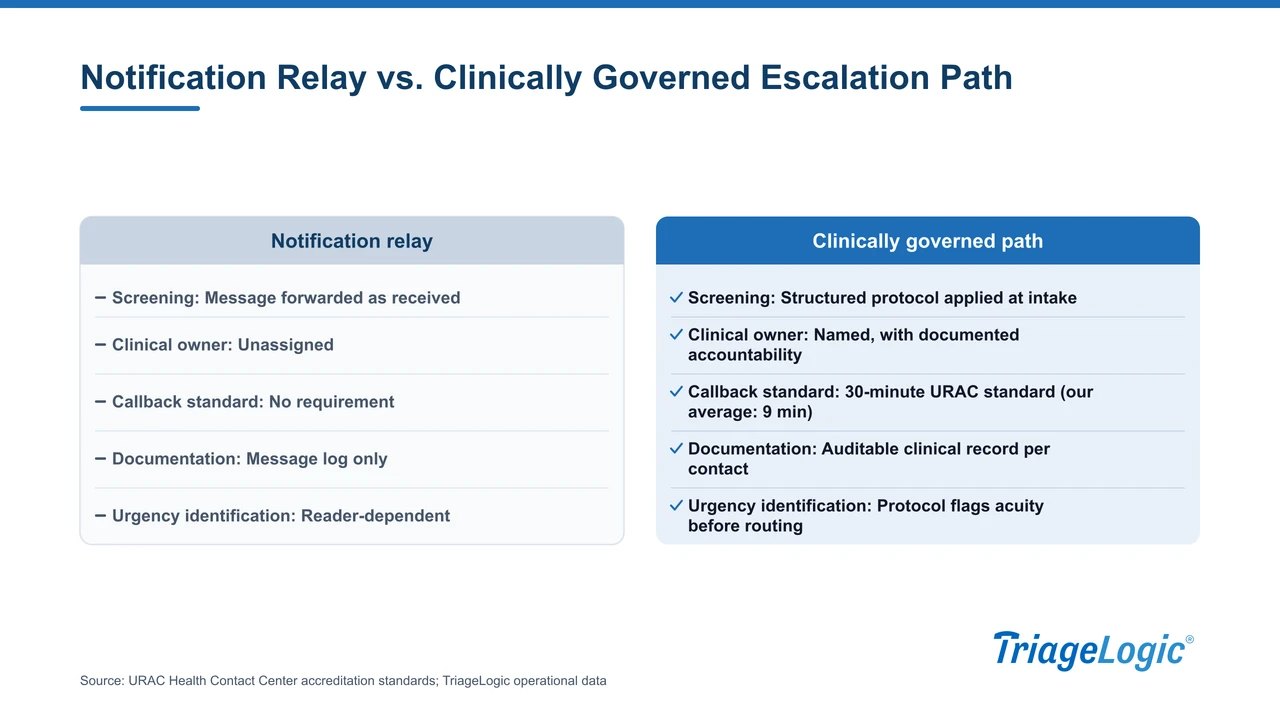
Clinical governance over messaging means every incoming contact is screened against a structured protocol, assigned a clinical owner, and documented before the queue moves on. A notification relay does none of that. It moves a message from one inbox to another and calls that escalation.

URAC’s Health Contact Center accreditation standards set the operational floor. Start with the staffing requirement: 24/7 registered nurse availability, around the clock. Evidence-based clinical guidelines come next, specifically Schmitt-Thompson protocols. Add documented clinical oversight of non-clinical staff, a 30-minute callback standard, and auditable records for every contact.
We hold URAC Health Contact Center (HCC) accreditation and meet each of these requirements. Our nurses call back based on acuity, averaging 9 minutes, well within that standard.
Protocol matters as much as availability. Our nurses follow Schmitt-Thompson protocols, the most widely adopted evidence-based triage guidelines in ambulatory care. After structured triage protocol training, correct nurse categorization rose substantially and over-triage dropped significantly, per peer-reviewed research. That gap is where patients fall through or get routed unnecessarily to the ER.
| Dimension | Notification relay | Clinically governed path |
|---|---|---|
| Screening | Message forwarded as received | Structured protocol applied at intake |
| Clinical owner | Unassigned | Named, with documented accountability |
| Callback standard | No requirement | 30-minute URAC standard (our average: 9 min) |
| Documentation | Message log only | Auditable clinical record per contact |
| Urgency identification | Reader-dependent | Protocol flags acuity before routing |
Hospital messaging volumes are climbing, and the difference between a relay and a governed path grows more consequential as message load increases.
Layering Structured Nurse Triage onto Existing Messaging Workflows
Adding clinical triage governance does not require replacing the messaging platform. It requires inserting a structured clinical layer before high-acuity contacts reach the same queue as administrative ones.
MedMessage Automate works within your existing phone workflow: patients call the number they already know, receive a secure text link, and complete intake through physician-developed, nurse-validated protocols. No app to download. No new number to publish. Routing of clinical and administrative contacts happens separately before anything reaches a human queue, so clinical staff address only clinical contacts from the moment they log on.
The protocols are fixed and auditable. No generative AI. Every request is handled by a person, not an algorithm. Clinical decisions remain with qualified clinical staff.
Always.
That distinction matters in hospital messaging environments. A misrouted urgent contact can sit unread for hours alongside a prescription refill. Generic inbox sorting does not prevent that. Structured clinical intake does.
Our physician-developed, nurse-validated intake protocols flagged 100% of patients who needed 911 as urgent. Among patients who needed ER care, 99.4% were flagged correctly. Those figures come from TriageLogic’s internal clinical validation data.
Beyond safety, approximately 1 in 6 of our triage calls helps a patient avoid an unnecessary ER visit. No generic inbox sorting produces that on its own. MedMessage Automate is built on more than 20 years of TriageLogic clinical and nurse triage operational experience, not on generative-AI agents improvising responses.
What Administrators and COOs Should Evaluate Before the Next Sentinel Event
The right question for operations leadership is not whether the messaging platform is HIPAA-compliant. It is whether every clinical contact arriving through that platform has a named clinical owner and a documented response timeline.
Most hospital messaging reviews stop at security and compliance. That is the wrong audit. A message can travel through an encrypted, HIPAA-compliant channel and still sit unreviewed for hours. The problem is an intake workflow that cannot distinguish a symptom report from a billing question at the moment it arrives.
Technology compliance does not fill that governance gap.
Before your next board review or sentinel event debrief, operations leadership should be able to answer these questions. Consider whether you can respond to each one with documented evidence:
- Does your current intake system separate symptom-based contacts from administrative requests before either enters the queue?
- Can you pull a documented escalation record for any clinically ambiguous message received in the last 30 days, including who received it, when, and what happened next?
- Is a registered nurse available around the clock to assess contacts that do not fit cleanly into an administrative category?
- Does your callback process reliably meet URAC’s 30-minute standard for urgent clinical contacts, and can you demonstrate that with data?
- When a refill request contains a symptom flag, does your intake path surface that flag to a clinician before the request is processed?
Digital Front Door separates administrative and clinical patient contacts from the first call. It combines MedMessage Automate’s structured intake with registered nurses following Schmitt-Thompson protocols. There is no setup fee. Onboarding typically completes in 30 days or less
A 30-day performance guarantee means practices can exit with one email if call volume does not drop.
Historical TriageLogic customer data shows practices have seen up to a 75% reduction in front-desk calls. Some have also seen up to 50% less clinical phone time. Results vary by organization, staffing, workflow, and implementation.
Frequently Asked Questions
Why can’t a hospital’s existing EHR messaging system handle clinical escalation?
EHR-Native messaging tools were built to move information between users, not to classify symptom severity or enforce a timed escalation response. They lack urgency-detection logic, read-receipt accountability, and the clinical oversight that URAC’s Health Contact Center accreditation standard requires.
What does URAC’s Health Contact Center accreditation require for clinical messaging?
URAC requires 24/7 registered nurse availability and evidence-based clinical guidelines such as Schmitt-Thompson protocols. It also mandates clinical oversight of non-clinical staff and callbacks within 30 minutes. Auditable documentation of triage outcomes is required as well. Learn more about URAC Health Contact Center accreditation.
How do Schmitt-Thompson protocols improve escalation accuracy?
Schmitt-Thompson protocols give nurses structured, peer-reviewed decision pathways for each symptom category. Structured triage protocol training has been shown to substantially lift correct nurse categorization while meaningfully dropping over-triage rates.
Can a structured triage layer work alongside our current messaging platform without replacing it?
Yes. A clinical triage layer inserts upstream of the existing inbox, screening contacts before they join the general queue. Patients reach it through the practice’s existing phone number, receive a secure text link, and their request routes by acuity rather than arrival order.
What is the safety record for structured clinical intake screening?
Our physician-developed, nurse-validated intake protocols flagged 100% of patients who needed 911 as urgent. They also flagged 99.4% of patients who needed emergency room care as urgent. Both figures come from TriageLogic’s internal clinical validation data.
Closing Thoughts
Better hospital messaging infrastructure will not close the escalation gap on its own. The missing piece is structural: no urgency-detection logic, no named clinical owner, no governed timeline. A better inbox is not a fix for a process that was never clinically governed to begin with.
Closing that gap requires a clinical layer placed between incoming patient contacts and the general queue. Our Digital Front Door puts registered nurses on Schmitt-Thompson protocols at exactly that point. It is backed by URAC Health Contact Center accreditation and a 30-day performance guarantee that removes most of the organizational risk from making the change.
Want a practical framework for auditing your current escalation path? Schedule a conversation with our team. We can walk through it with you before you commit to anything.
To map this to your operation, reach out to our team.