
In 2024, the Office for Civil Rights closed 22 HIPAA enforcement investigations with civil monetary penalties or settlements. Fourteen of those 22 involved Security Rule failures, according to HIPAA Journal. That detail should stop any administrator cold. A signed Business Associate Agreement was present in nearly every one of those cases.
The BAA is a legal prerequisite, not a compliance strategy. Treat it as the finish line when evaluating a HIPAA-compliant medical answering service, and your practice carries exposure you may not discover until a breach investigation is already open.
The harder question is what happens after the call connects. Which staff member decides whether a patient’s concern is urgent? Under what protocol? What happens at 2 a.m. when a caller mentions chest tightness alongside a refill request?
Clinical judgment, structured intake, and the right escalation path matter as much as encryption, and often more.
The Four Safeguards Every Medical Answering Service Must Verify
A signed BAA is a mandatory starting point, not a compliance certificate. True HIPAA compliance for a medical answering service requires four concrete safeguards. First, a signed BAA. Second, end-to-end encryption for all PHI transmitted by phone or message.
Third, role-based access controls with audit logging. Fourth, documented breach notification procedures. All four must be in place before a vendor handles a single patient call.
The legal stakes are real. Since the 2013 HIPAA Omnibus Rule, business associates have carried direct liability for civil monetary penalties. The Office for Civil Rights can investigate and penalize a medical answering service independently of the covered entity it serves.
A BAA describes obligations. It does not, by itself, satisfy the Security Rule’s administrative, physical, and technical safeguard requirements.
Encryption deserves particular attention. HHS has proposed rules that would make encryption of PHI at rest and in transit a mandatory requirement. Under the current framework, it remains an “addressable” specification. Vendors who treat encryption as optional are building toward a compliance gap.
Ask any vendor two specific questions: is PHI encrypted in transit, and is it encrypted at rest? “HIPAA-compliant” as a label answers neither.
Use this checklist as a starting point. For a broader framework, our guide to evaluating any medical call center vendor covers security, clinical protocols, and operational fit together.
- Sign the BAA before any PHI is handled. A legal prerequisite, not a formality to complete later.
- End-to-end encryption for PHI. Confirm coverage both in transit (calls, messages) and at rest (stored records).
- Role-based access controls. Only staff who need access to specific PHI should have it. Log every access event.
- Audit trails. Capture who accessed what and when, so any anomaly can be traced back to its source.
- Documented breach notification procedures. Under 45 CFR sections 164.400-414, a business associate must notify the covered entity no later than 60 calendar days from discovery of a breach. Ask vendors how they track that clock and who owns the notification.
- SOC 2 Type II attestation or equivalent. An independent report that security controls are operating, not just documented.
Why the Real Compliance Risk Sits After the Call Connects
Encryption protects data in transit. It does nothing about the routing decision a non-clinical receptionist makes the moment a caller describes chest tightness. That routing decision is where clinical liability actually lives.
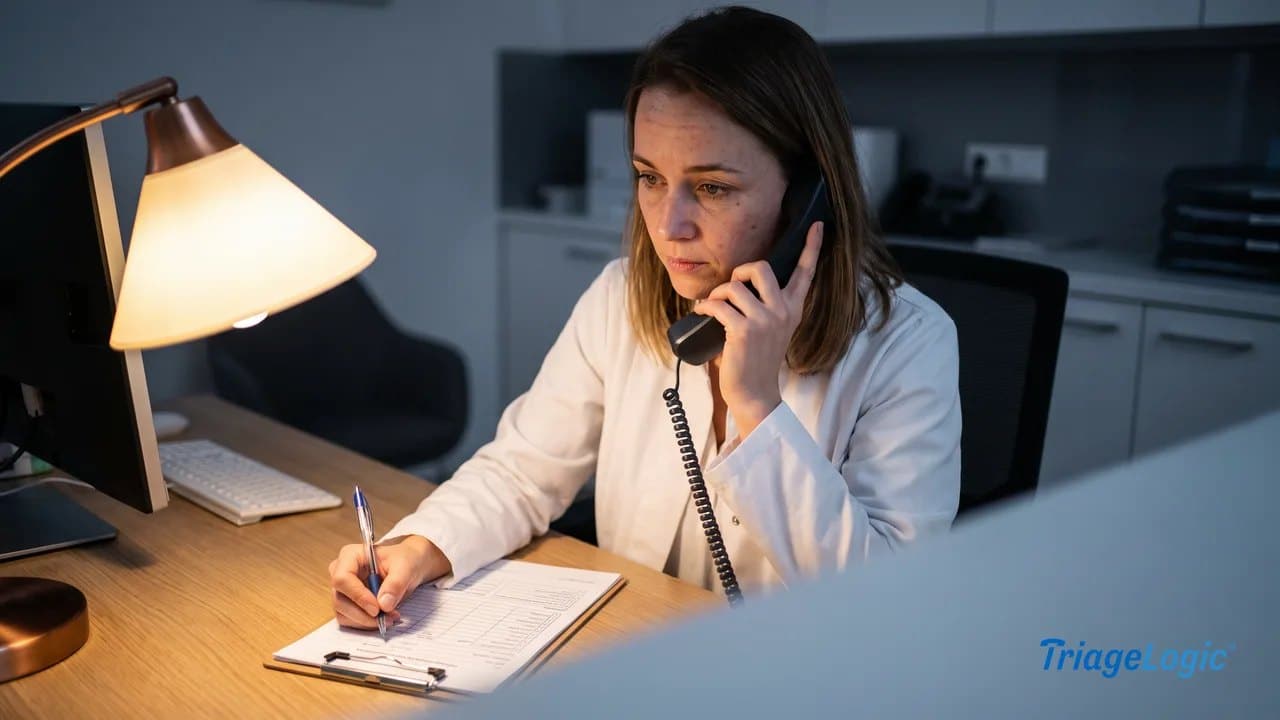
A peer-reviewed narrative review published in PubMed (Murdoch et al.) examined when telephone triage is least safe. After hours. That is precisely when clerical staff and solo physicians with the least complete decision-support systems are managing calls. The authors concluded that the person making the triage decision should be a clinician, at minimum.
A 2025 observational study reinforced that point: clinician-led triage is measurably more accurate at identifying patients who need emergency room or in-patient care than non-clinician triage.
The Doctors Company defines triage as a process requiring a health care professional to exercise independent clinical judgment. Courts have given that definition teeth. A 2015 Louisiana ruling held a cardiologist liable for malpractice because he failed to respond to an after-hours call. Correct routing depends on a qualified clinician interpreting the call, not a receptionist making a judgment call alone.
Consider a front-desk operator taking a routine refill request. The patient mentions, almost in passing, that the pain has been different lately. Without a structured clinical protocol, that detail goes unexamined. The call lands in a voicemail queue.
There is no audit trail. No qualified clinician was involved, and there is no one accountable if the outcome is bad.
Our guide to nurse triage protocols explains why the protocol layer is not optional.
Schmitt-Thompson Protocols and URAC Accreditation: The Clinical Standard That Matters
When a nurse triage service says it follows clinical protocols, one credential actually means something. That credential is URAC Health Contact Center (HCC) accreditation. It matters specifically when nurses operate on Schmitt-Thompson protocols, the most widely used telephone triage framework in North America.
What URAC HCC Accreditation Requires
URAC Health Contact Center (HCC) accreditation is the only national credential dedicated to health contact centers. That specificity is what makes it verifiable accountability, not a marketing claim. It sets measurable operational standards: live answer speed, call abandonment rates, and nurse callback times. Broad language about “clinical excellence” is easy to print on a website; these standards require numbers.
We hold URAC HCC accreditation and average 9 minutes for a nurse callback, well within that standard. Nine minutes is not a rounding convention; it is a documented operational result. For any organization evaluating a HIPAA-compliant medical answering service, that accreditation is a concrete signal of operational discipline, and the callback time is the proof behind it.
Why Schmitt-Thompson Protocols Set the Bar
Schmitt-Thompson protocols have defined the telephone triage standard for more than 30 years. They are evidence-based and peer-reviewed annually. New protocols are added each cycle, which means nurses apply current clinical guidance rather than static scripts from a prior decade.
A protocol tells a nurse exactly which symptom patterns require an immediate 911 transfer, which warrant an urgent same-day visit, and which can safely wait. That structured decision tree is what separates a trained clinical response from a generalist answering questions by feel.
Our physician-led network covers more than 42.5 million lives and includes more than 22,000 physicians. Every clinical call runs on Schmitt-Thompson protocols. Approximately 1 in 6 of our triage calls helps avoid an unnecessary ER visit. If you want to understand how URAC-accredited nurse triage on call works for after-hours coverage, our guide walks through the operational structure in detail.
Intelligent Routing: What Separates a Clinical-Grade Service from a Commodity One
The question that separates services is not “are you HIPAA-compliant?” It is: who makes the routing decision, by what clinical protocol, and how is it documented? MedMessage Automate, part of our Digital Front Door solution, automates that routing without adding staff or changing your practice’s existing phone number.
A patient calls your practice’s existing number and receives a secure text link. No app to download. A structured digital pathway guides intake, and administrative requests route to your practice staff. Clinical requests and refills route to your nurses, our nurses, or both, depending on your workflow configuration.
Every step uses physician-developed, nurse-validated fixed protocols. No generative AI. Full stop. A person handles every request, without exception, and that consistency is what makes the system reliable at scale.
That structure matters most when urgency hides in a routine request. A refill message that mentions worsening chest discomfort surfaces as potentially urgent through our fixed clinical screening. A non-clinical operator reading the same message in a phone queue would likely process it as a standard callback. The difference is protocol depth, not staffing volume.
The safety results bear that out:
- 100% of patients who needed 911 were flagged as urgent by our structured intake screening.
- 99.4% of patients who needed emergency room care were flagged as urgent before reaching clinical staff.
- MedMessage Automate shifts roughly 65% of routine front-desk calls to text from day one, without altering your existing workflow.
- SOC 2 Type II attestation and full HIPAA compliance are built into the platform, not layered on after the fact.
The Operational and Financial Case for Upgrading from Compliance to Clinical Intelligence
A service that only checks the HIPAA boxes leaves measurable cost and clinical risk on the table. MedMessage Automate returns staff capacity that practices can quantify from the first month.
Onboarding takes a single 40-minute meeting, and practices go live within one month. In one early deployment, 350 requests were handled by text in the first 48 hours, before staff had time to change a single workflow. That kind of immediate volume shift is what separates a genuinely capable HIPAA-compliant medical answering service from a system that simply stores messages safely.
The financial picture scales quickly. For a 25-physician practice handling 5,000 text requests per month, MedMessage Automate saves roughly 6 minutes per request, returning 500 hours of staff capacity each month. At $25 per hour, that is $12,500 in monthly staff-time value against a $6,250 MMA cost: a $75,000 annual net benefit and a 2.0x gross return. The service pays for itself at 2,500 requests per month.
The patient-facing numbers reinforce the operational ones. Front-desk call volume drops 75%, clinical phone time drops more than 30%, and over 95% of patients say they would use the system again. There is no setup fee and a 90-day money-back guarantee. For the full capability and ROI detail, download the MedMessage Automate guide.
| Metric | Baseline (no MMA) | With MedMessage Automate |
|---|---|---|
| Front-desk call volume | 100% | Down 75% |
| Clinical phone time | Baseline | Down 30%+ |
| Staff hours recovered | 0 | 500 hrs/month (25-physician model) |
| Monthly net staff-time value | $0 | 12,500 value minus $6,250 cost) |
| Patients who would use again | N/A | Over 95% |
Frequently Asked Questions
What does HIPAA actually require of a medical answering service?
Any answering service that handles patient calls on behalf of a covered entity is a Business Associate under HIPAA. That status carries direct obligations under the Privacy Rule, Security Rule, and Breach Notification Rule. The service must sign a BAA before handling any PHI. It must also implement end-to-end encryption, maintain role-based access controls with audit logs, and have documented breach notification procedures in place.
Is a signed BAA enough to make a medical answering service HIPAA compliant?
No. A BAA documents obligations; it does not satisfy the Security Rule’s administrative, physical, and technical safeguard requirements. OCR can investigate and penalize business associates independently. Fourteen of the 22 enforcement actions closed in 2024 involved Security Rule failures, not missing BAAs.
What is the legal risk when non-clinical staff handle patient calls?
Non-clinical operators have no structured triage protocol and no clinical training. They carry no documented accountability for routing decisions. Peer-reviewed research finds telephone triage is least safe after hours when clerical staff manage calls. Courts have found physicians liable for malpractice when after-hours calls were not properly triaged and returned.
What are Schmitt-Thompson protocols and why do they matter for a medical answering service?
Schmitt-Thompson protocols are the most widely used telephone triage framework in North America, applied broadly across medical triage call centers. They are evidence-based, peer-reviewed annually, and updated with new clinical content each cycle. Our nurses follow physician-approved Schmitt-Thompson protocols on every clinical call.
What is URAC Health Contact Center accreditation, and does TriageLogic hold it?
URAC Health Contact Center (HCC) accreditation is the only national credential dedicated to health contact centers. Its Clinical Contact Center module applies when licensed RNs perform health triage using clinical protocols. We hold URAC HCC accreditation and return nurse calls in about 9 minutes on average, well within URAC’s 30-minute callback standard.
Closing Thoughts
HIPAA compliance is table stakes. Every qualified medical answering service owes you a signed BAA and encrypted channels before the first message touches PHI. After that, the harder questions begin. Who routes the request?
By what clinical logic? Does a routine refill note that mentions chest tightness ever reach a nurse who can act on it? Those are the gaps where patient safety and practice liability actually live.
Our Digital Front Door pairs MedMessage Automate’s physician-designed structured intake routing with URAC-accredited nurses following Schmitt-Thompson protocols. It goes live in two weeks, reduces front-desk calls by 75%, and carries a 90-day money-back guarantee. If you want to walk through your practice’s specific call patterns before committing to anything, reach out and we can show you exactly how it fits.
For the full picture, see the how Digital Front Door works.