
Your practice can meet APCM’s 24/7 access requirement without putting physicians on a nightly call rotation. When CMS finalized the CY 2025 Physician Fee Schedule, they clarified what 24/7 access actually means: reasonable after-hours care when necessary. A physician sitting by the phone with live record access is not required. The documentation piece, however, is firm: whoever responds after hours must record that interaction and communicate it back to the primary care team.
That is precisely the workflow outsourced registered nurse triage is built to execute. Nurses follow Schmitt-Thompson clinical protocols, assess the caller, and act on acuity. They then generate a documented call note that goes directly to the care team. APCM requirements describe that process almost exactly.
What APCM Is and Why the 13 Service Elements Are Not All Equal
Advanced Primary Care Management is a Medicare monthly care management bundle effective January 1, 2025. It is billed with HCPCS codes G0556, G0557, or G0558 depending on patient complexity. Unlike Chronic Care Management, APCM has no monthly time threshold. A practice must demonstrate capacity across all 13 service elements, not log minutes.
That structural difference matters. A practice cannot satisfy APCM requirements by documenting a 20-minute care coordination call and moving on. CMS treats billing the code as attestation that every element is in place for every enrolled patient, every month. Confirm your eligibility and documentation approach with your compliance or billing team before you bill.
The CMS APCM services FAQ lists all 13 elements and eligible specialties. Most describe work primary care practices already do:
- Patient consent obtained before services begin
- Initiating visit to establish or confirm the care relationship
- Continuity of care with a designated practitioner or care team
- Comprehensive care management including medication management and chronic disease monitoring
- Patient-centered care plan documented and shared with the patient
- Care transitions coordination after hospitalizations or specialist encounters
- Ongoing communication and care coordination with other treating providers
- Enhanced communication access for patients between visits
- Population data analysis to identify and manage high-risk patients
- Risk stratification applied to enrolled patients
- Performance measurement to track and improve care quality
- Alternative care delivery options such as home visits or telehealth where appropriate
- 24/7 access to a care professional for urgent needs at any hour
Twelve of those elements describe clinical and operational workflows most primary care teams already manage. The thirteenth is different. Around-the-clock access requires a staffing answer, not just a care model. That is where most practices need to look honestly at what they currently have in place.
What the 24/7 Access Element Actually Requires
CMS’s CY 2025 Final Rule states that 24/7 access means patients or caregivers can reach a health care professional to discuss urgent needs at any hour. Crucially, the rule does not require the after-hours responder to have real-time access to the full medical record.
What the Federal Register does require is narrower than many practices assume. The after-hours responder must document the interaction and communicate it back to the primary care team. That communication must then be entered into the patient’s record. The standard is a reliable loop, not a live EHR feed at 2 a.m.
CMS is equally clear about documentation burden. Proof of 24/7 capability does not need to appear in every patient’s monthly chart. Documentation is triggered only when a patient actually uses the after-hours service. The AAFP confirms this plain-language reading: billing an APCM code is itself an attestation that the capability exists and all APCM requirements are met.
The practical implication is significant. A practice needs a consistent, auditable system where after-hours calls are handled, documented, and routed back to the care team. How well that system holds up depends entirely on who is following documented clinical protocols and how rigorously.
Three Ways Practices Cover Nights: What Each One Means for APCM Compliance
Most primary care groups rely on one of three after-hours models: physician call rotation, a traditional answering service, or a registered nurse triage line. Only one reliably meets both the clinical-assessment and documentation standards CMS requires.

Physician call rotation is clinically sound but expensive in human terms. More than two in five U.S. primary care physicians report burnout, according to the Commonwealth Fund, with on-call burden cited as a consistent driver. When a physician fields every after-hours call personally, the coverage is real but the cost compounds nightly.
A traditional answering service takes a message and relays it. That is the full extent of its function. No clinical assessment is performed, no urgency is established, and no structured triage note routes back to the care team. CMS expects a clinical interaction; a transcribed callback request is not one.
A registered nurse triage line changes the equation. The RN assesses the patient using structured protocols, determines urgency, and produces a documented call record that travels back to the care team. According to AMA STEPS Forward data, fewer than 10 percent of primary care after-hours calls required physician escalation under a nurse-first model. Physicians sleep, and patients still receive a clinical response.
When evaluating your options, these criteria separate a compliant model from an insufficient one:
- Whether a licensed clinician performs a real-time clinical assessment on the call
- Whether a structured triage note is generated and sent to the care team
- Whether the model requires physician involvement for routine, low-acuity calls
- Whether documentation lands in the patient’s record as CMS requires when after-hours care is used
- Whether the model is sustainable for your physicians over months, not just on paper
The table below maps each model against the criteria that matter most for APCM compliance.
| Criterion | Physician Rotation | Answering Service | RN Nurse Triage |
|---|---|---|---|
| Clinical assessment performed | Yes | No | Yes |
| Documented communication back to care team | Varies | No | Yes |
| Physician required for routine calls | Yes | No (no assessment given) | Rarely |
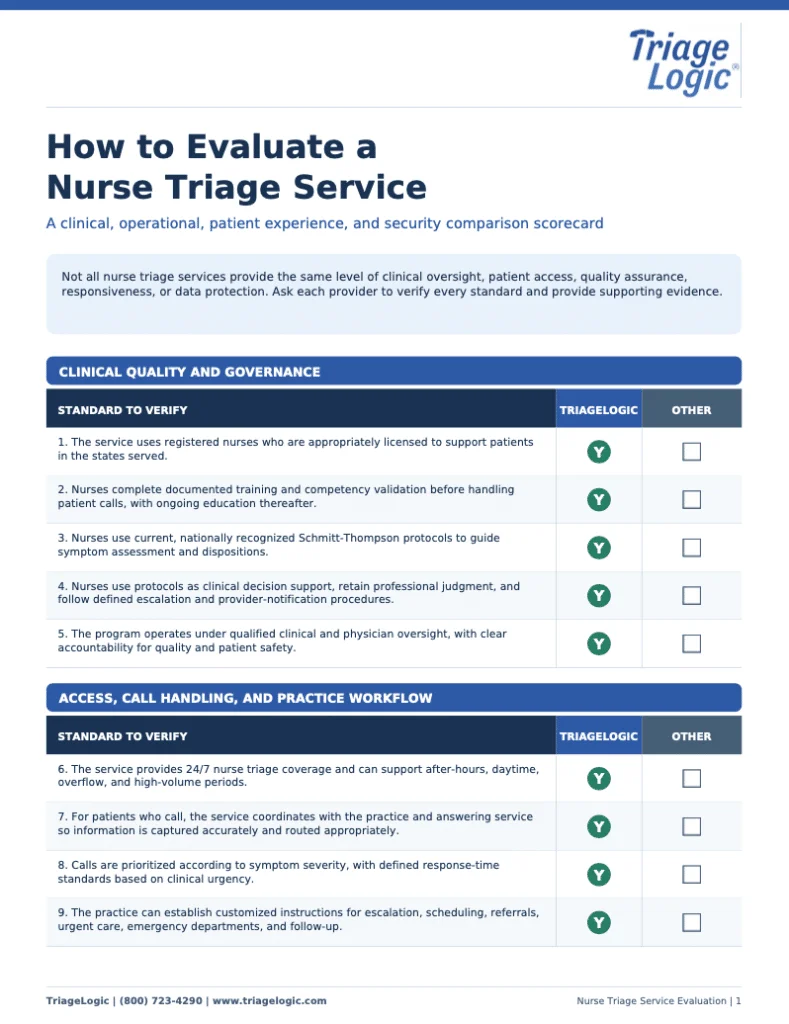
If you are weighing your options carefully, reviewing the criteria for evaluating an after-hours call coverage vendor before you commit will save significant rework later.
How Registered Nurse Triage Satisfies the APCM Documentation Standard
A registered nurse using Schmitt-Thompson protocols assesses each caller’s urgency and selects the appropriate disposition. The nurse then generates a structured call note covering the chief complaint, protocol used, care level recommended, and any physician escalation. That is exactly what CMS’s 24/7 access element requires, and it produces the documentation the practice needs to enter into the patient’s record.

Schmitt-Thompson protocols are updated annually. A published study at a pediatric endocrinology practice found that a nurse triage service using these protocols handled 70 percent of after-hours calls without physician involvement. The study called them the standard for telephone triage care in North America. That standing is reflected in how consistently medical call centers across the continent have adopted them.
The structured call note is what makes the documentation loop close. It goes back to the practice the same night, ready for record entry. No chasing it down the following morning. The care team simply receives it, reviews it, and enters it.
At TriageLogic, our nurse triage call center holds URAC Health Contact Center (HCC) accreditation and returns calls in about 9 minutes on average, well within URAC’s 30-minute benchmark. Approximately 1 in 6 of our triage calls helps avoid an unnecessary ER visit. All clinical decisions are made by licensed nurses, not automated systems.
For practices evaluating how our after-hours nurse triage line is structured for primary care, the operational model is straightforward. The nurse handles the call and documents it. The note routes back to the care team, and your staff records it. No physician needs to be on call every night to satisfy the standard.
A Readiness Checklist Before You Bill APCM
Before submitting the first APCM claim, confirm that every one of the 13 service elements is in place, not just 24/7 access. Billing the code is itself an attestation that all APCM requirements are met.
The element that trips up most practices at the start is documentation flow for after-hours contacts. A message-relay service that records a patient’s callback number and nothing else does not satisfy the requirement. CMS requires that the after-hours responder document the interaction and communicate it back to the primary care team, with a note in the patient’s record. That is something a message-relay service cannot provide.
Our outsourced nurse triage page shows what that documentation pathway looks like in operation.
Work through this list before billing the first month:
- Patient consent documented (written or verbal) prior to the first billing month
- Initiating visit completed before or during the same calendar month as the first claim
- Written, patient-centered care plan in place and accessible to the care team
- 24/7 access solution confirmed with a structured documentation pathway and a route back to the care team, not a voicemail handoff
- Complexity tier matched to the right code: G0556 for low-complexity, G0557 for moderate, G0558 for high
- No duplicate billing: APCM cannot be billed in the same month as CCM, PCM, or TCM for the same patient
This checklist is an operational orientation only. Confirm eligibility, documentation requirements, and billing decisions with your compliance or billing team before submitting any APCM claim.
Frequently Asked Questions
Does an answering service satisfy APCM’s 24/7 access requirement?
No. An answering service takes a message and relays it but performs no clinical assessment and produces no structured triage documentation. CMS requires that the after-hours responder document the interaction and communicate it back to the care team for entry into the patient’s record. A message-relay service cannot provide that.
Does the after-hours nurse need real-time access to the patient’s EHR to meet APCM standards?
No. CMS’s CY 2025 Final Rule explicitly states there is no requirement for real-time medical record access. The requirement is that the interaction is documented and communicated back to the primary care team.
Which HCPCS code should a practice use for APCM?
CMS uses G0556 for patients who are not high-need. G0557 applies to patients with one or more chronic conditions. G0558 applies to patients with two or more chronic conditions placing them at significant risk. Confirm the correct code assignment with your billing or compliance team.
Can FQHCs participate in APCM?
Yes. FQHCs and Rural Health Clinics can participate in APCM and receive separate payment. As of October 1, 2025, they are required to use the specific G-codes rather than the legacy G0511 bundle, per CMS guidance.
If a patient never uses after-hours access in a given month, does the practice still need to document the 24/7 capability in that patient’s record?
No. CMS does not require monthly documentation of the practice’s 24/7 capability in each patient’s chart. Documentation is required only for the months when a patient actually contacts the after-hours service.
Closing Thoughts
Solving APCM’s 24/7 access requirement comes down to a single question: who answers when a patient calls at 11 p.m., and what happens to that interaction afterward? Physician call rotations burn out the people your practice depends on. A message-relay service leaves a documentation gap that CMS’s final rule language specifically anticipates during audits.
Registered nurses working from Schmitt-Thompson protocols satisfy what the regulation actually requires. Structured call notes route back to the care team, and your physicians carry no overnight burden to make it happen.
TriageLogic holds URAC Health Contact Center accreditation and handles after-hours calls for primary care practices every night. See how our registered nurses provide after-hours coverage for your practice and what that looks like inside an APCM workflow.
To go deeper, download how TriageLogic’s registered nurses cover after-hours calls for your practice.