
A nurse triage service that meets your price target but lacks documented clinical governance is not a safe choice. That gap is unquantified risk. Scrutiny across five domains is non-negotiable: clinical governance, call handling, patient experience, quality assurance, and data security.
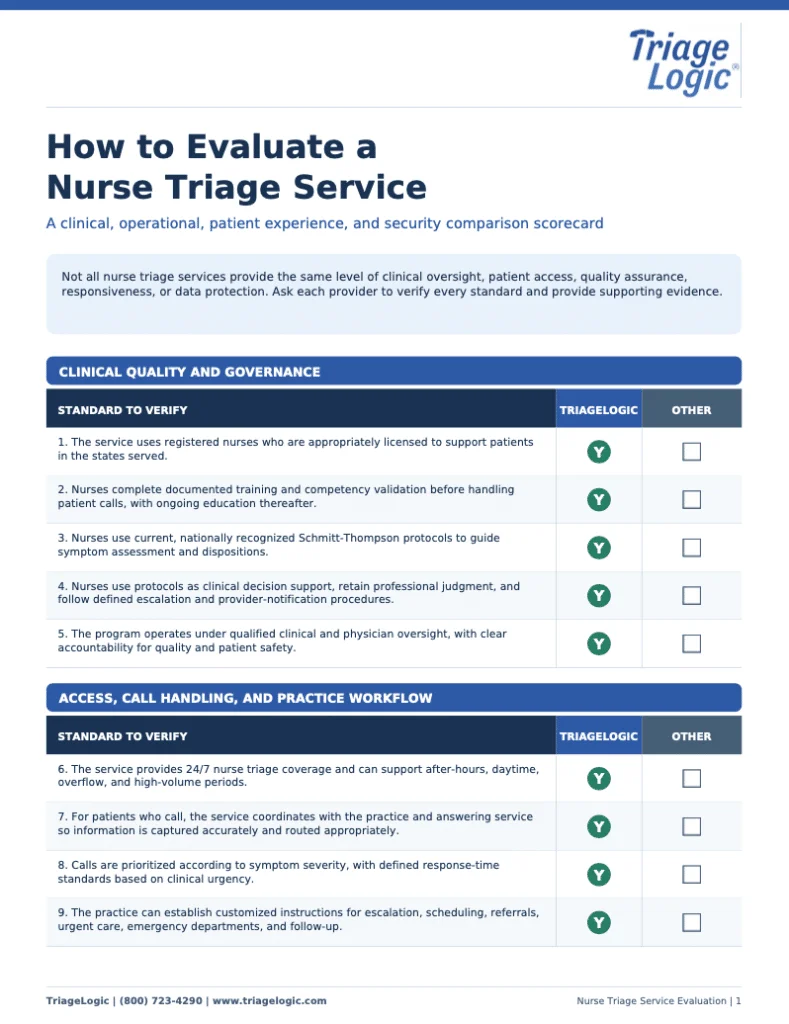
Most evaluation conversations stop at price and coverage hours. That is exactly where consequential differences hide. Our vendor comparison scorecard formalizes that scrutiny into 17 verifiable standards. What a vendor cannot answer is often as revealing as what they can.
Clinical Governance: The Foundation Every Other Standard Rests On
Three things must be confirmed before evaluating response times or pricing. Every nurse handling patient calls needs appropriate RN licensure, documented training on current Schmitt-Thompson protocols, and qualified physician oversight. These are not aspirational qualities. A credible vendor can document all three on request.

Schmitt-Thompson updates its guidelines annually, with review conducted through the American Academy of Pediatrics. Peer-reviewed evidence backs consistent, reproducible call quality under those guidelines. A nurse who deviates from protocol without a defined escalation path creates undertriage risk. That risk surfaces only after something goes wrong.
Protocol-guided judgment separates a clinically defensible nurse triage service from a call center that happens to employ nurses. Clear escalation procedures make that separation visible and verifiable.
Nightingale College, citing HRSA projections, reports a 10% registered nurse shortage by 2026. Closing that gap will require approximately 350,000 FTEs. Vendors feeling that pressure sometimes fill gaps with non-RN staff. That substitution may be invisible in a sales conversation and consequential in a patient interaction.
Our nurses follow physician-approved Schmitt-Thompson clinical protocols inside a physician-led network. That network covers more than 42.5 million lives and is built on 20+ years of clinical and operational experience. Five governance standards every evaluation should verify:
- RN licensure by state for every nurse handling calls, verifiable on request
- Documented training and competency validation completed before a nurse takes a live patient call, with ongoing education thereafter
- Current Schmitt-Thompson clinical content, updated annually and in active use (not a legacy version)
- Defined escalation procedures so protocol deviations have a structured, documented path rather than a judgment call made in isolation
- Qualified physician oversight with clear accountability for program quality and patient safety
Download the TriageLogic guide to nurse triage protocols and Schmitt-Thompson clinical content. It provides a full look at how these standards translate into day-to-day call quality.
Call Handling and Practice Workflow: Where Clinical Intent Meets Operational Reality
Reaching the right patient in the right timeframe is the core test of any nurse triage line. Instructions must also match your practice‘s specific escalation preferences. Standards 6 through 9 on the scorecard address exactly that: coverage availability, handoff accuracy, call prioritization, and instruction customization.
Coverage hours matter more than vendors typically admit. A published pediatric endocrinology study found that an after-hours nurse triage service resolved 70% of calls without physician involvement, per the Journal of Diabetes Science and Technology. That is a structural reduction in after-hours burden. Separately, KLAS Research identified after-hours work as a primary driver of physician burnout.
A well-designed nurse triage service does not patch that problem. It removes a large share of it entirely.
Response time is where operational credibility becomes measurable. Speed matters. URAC’s Health Contact Center standard requires callbacks within 30 minutes, and our nurses average 9 minutes, well within that benchmark. Think about what that difference means: a parent deciding whether to drive to the ER at midnight, with the decision hinging on how quickly someone calls back.
Vague answers from a vendor on actual callback times are a signal worth noting.
When you evaluate standards 6 through 9, ask each vendor to document the following:
- Whether coverage spans after-hours, overnight, weekends, overflow, and high-volume daytime periods
- How handoffs between the answering service and triage nurses are structured so nothing is lost between steps
- What call prioritization criteria the service uses, and whether response-time standards differ by clinical urgency
- Whether escalation instructions, referral pathways, and ER guidance can be customized to your practice’s protocols
- How the service documents and confirms that escalation preferences were followed on each call
Download the Nurse Triage On Call guide covering after-hours coverage and call handling standards for a fuller look at what well-structured call handling looks like in practice.
Patient Experience and Quality Assurance: The Standards That Separate Good from Verifiable
Patient satisfaction rates of 94% to 99% are achievable in nurse triage programs, according to the Journal of Diabetes Science and Technology. Reaching that range requires two things working together: accessible intake options and a formal QA program that reviews and measures every interaction. Standards 10 through 13 define that combination.
Patient Access: Text as a Clinical Pathway
Patients who reach a nurse triage service should not have to earn that access by surviving a hold queue. We support a secure text pathway that lets patients send their concerns directly to the triage team, bypassing the answering service layer entirely. Over 95% of patients who use that pathway say they would use it again. See how MedMessage Automate provides secure text-based patient intake as part of Digital Front Door.
Quality Assurance: Documentation, Recording, and Reporting
A QA program is only as strong as what it actually reviews. Calls should be documented and recorded, and the program should include consistent quality control review across interactions, not just a count of volume. Approximately 1 in 6 of our triage calls helps avoid an unnecessary ER visit, and that outcome stays consistent only when nurses receive regular, structured feedback on their performance.
Meaningful reporting goes well beyond call volume. Ask any candidate service what their dashboards actually show:
- Call activity and response times, broken down by urgency tier
- Disposition patterns, so you can track whether clinical routing is consistent
- Nurse-level performance data tied to QA review cycles
- Quality scores alongside operational metrics, not separated from them
- Trends over time, not just point-in-time snapshots
A credible nurse triage service should meet all three review categories: documentation review, call recording review, and peer review. Missing any one of them leaves blind spots that no volume metric can fill.
Data Analytics, Security, and Independent Accreditation: The Questions Most Buyers Skip Until It Is Too Late
Healthcare data breaches averaged $9.77 million per incident in 2024, the highest of any industry for the 14th consecutive year, according to Healthcare Dive. A triage vendor’s security architecture is a material financial risk question. Accreditation status is independently verifiable.

Most buyers review clinical quality and call response times, then accept whatever reporting the vendor chooses to send. Standard 14 flips that dynamic: your contract should include direct access to a reporting portal showing your own call data, response times, and dispositions on demand. Summary reports delivered on the vendor’s schedule tell you what they want you to see. A live portal tells you what is actually happening.
Security protocols deserve the same scrutiny. In 2024, a threat actor maintained access to a healthcare after-hours call platform for roughly three months. That breach exposed the protected health information of 914,138 individuals, according to HIPAA Journal. Any nurse triage service you evaluate should describe its HIPAA-compliant communication pathways, access controls, incident-response procedures, and business-continuity plans in writing.
Accreditation and attestation are the two independent verification points that separate documented claims from actual evidence. URAC Health Contact Center (HCC) accreditation is the only national credential with a dedicated program for nurse triage lines, covering 24/7 RN access, defined protocols, and 30-minute callback standards. We hold that accreditation.
Our technology platform has also achieved SOC 2 Type II attestation, providing independent verification of security, availability, and confidentiality controls. When a vendor cannot produce accreditation documentation or SOC 2 attestation, that silence is itself an answer.
If you want a structured framework for all 17 standards, download the TriageLogic guide to evaluating a medical call center, with vendor comparison criteria.
| Standard | What to verify | TriageLogic |
|---|---|---|
| Data analytics access (Standard 14) | Direct portal access to your own call data and metrics | Clients have direct portal access |
| Security and HIPAA compliance (Standard 15) | Documented access controls, incident response, and business continuity | HIPAA-compliant; SOC 2 Type II attested |
| National accreditation (Standard 16) | URAC Health Contact Center (HCC) accreditation | Accredited |
| Independent security attestation (Standard 17) | SOC 2 Type II covering security, availability, and confidentiality | Attested |
Frequently Asked Questions
What is the difference between a nurse triage service and a medical answering service?
A medical answering service routes calls and takes messages. A nurse triage service puts a licensed registered nurse on the line to assess symptoms using structured clinical protocols such as Schmitt-Thompson, and determine the appropriate level of care. Clinical judgment requires documented training and physician oversight that an answering service simply does not provide.
How do I verify that a nurse triage service is URAC accredited?
Ask the vendor for their URAC Health Contact Center (HCC) accreditation certificate and confirm the expiration date. URAC HCC accreditation runs on a three-year cycle. URAC maintains a public directory of accredited organizations you can cross-reference independently at urac.org.
What response-time standard should I expect from a nurse triage line?
URAC HCC sets a callback benchmark of 30 minutes. Ask any vendor for documented response-time data, not just a stated policy.
Is a standalone nurse triage line enough, or do I need a full Digital Front Door?
Nurse Triage On Call is available as a standalone service and handles clinical call triage around the clock. Some practices also want to shift routine administrative and refill requests away from the front desk via secure text intake. For those practices, our Digital Front Door combines Nurse Triage On Call with MedMessage Automate as one solution, with no setup fee and a 30-day performance guarantee.
What security documentation should I require from a nurse triage vendor?
Request a signed Business Associate Agreement, evidence of HIPAA-compliant communication and access controls, an incident-response policy, and SOC 2 Type II attestation covering the technology platform. A vendor that cannot produce all four presents regulatory and financial exposure.
Closing Thoughts
Price is the easiest line item on a vendor comparison spreadsheet. Clinical governance, call-handling discipline, patient access design, formal quality assurance, and data security are harder to evaluate. These are not equivalent categories. The cost of getting any one of them wrong falls on your patients and your practice, not on the vendor’s invoice.
Our 17-standard scorecard gives practice administrators and clinical leaders a consistent evidentiary framework. It holds every service to the same bar. You end up comparing what actually matters rather than what is easiest to quote.
Depending on where your organization is in the evaluation process, here are three natural next steps:
1. Download the full 17-standard checklist and work through it with every vendor you are considering. Get the nurse triage service evaluation guide.
2. See how Digital Front Door works in practice, combining Nurse Triage On Call with MedMessage Automate as one integrated solution. Explore Digital Front Door.
3. Talk to our team when you are ready to move from evaluation to decision. A 15-minute conversation is enough to cover your coverage gaps and get a clear picture of fit. Schedule a conversation.