
By January 1, 2027, three separate policy shifts land on rural providers simultaneously. Medicaid work requirements put coverage at risk for an estimated 2.3 million enrollees, per Healthcare Dive reporting on CMS’s interim final rule. Year-two Rural Health Transformation Program awards hinge on year-one state performance. Medicare telehealth flexibilities expire at year-end.
After-hours coverage is where the fracture shows first. Patients who lose insurance do not stop having 2 a.m. problems. They default to the emergency room instead.
A 24 hour nurse line addresses all three pressures at once, without adding clinical headcount. Rural hospitals can no longer afford full emergency room staffing. A nurse line keeps patients out of the ER. It supports the access and utilization goals that RHTP performance reviews will measure.
It also fills the after-hours gap that telehealth extensions alone cannot close.
Three Clocks Running at Once
The first clock is the RHTP spending deadline. Budget Period 1 runs from December 29, 2025 through October 30, 2026. Year-one funds must be fully obligated and spent by September 30, 2027, according to KFF. CMS announces year-two award amounts by October 31, tied directly to state performance reports due August 31, 2026.
Organizations with incomplete spend plans risk leaving federal dollars on the table while losing the next tranche.
The second clock starts January 1. Medicaid work requirements take effect then, mandating 80 hours per month of qualifying activity to maintain ACA expansion coverage, according to Healthcare Dive. Rural residents face greater compliance barriers than urban counterparts. CMS projects 2.3 million people will lose Medicaid enrollment that year, and nearly 1 in 4 rural residents relies on Medicaid, per KFF.
That enrollment drop reduces revenue fast and pushes more visits into emergency settings. The income statement feels it immediately.
The third clock resets at midnight December 31. Medicare telehealth flexibilities, including geographic waivers and home originating site coverage, expire December 31, 2027, per Baker Donelson. The California Medical Association notes that CMS retired the G2025 billing code for RHCs and FQHCs on October 1, 2026, per the California Medical Association. Each expiration tightens operating margin further.
Key dates in concrete terms:
- October 1, 2026: RHC and FQHC G2025 billing for non-behavioral telehealth retires; individual CPT/HCPCS codes required
- October 31, 2026 (annually): CMS sets year-two RHTP amounts based on state progress reports due August 31
- January 1, 2027: Medicaid work requirements begin; CMS projects 2.3 million coverage losses
- September 30, 2027: Year-one RHTP funds must be fully spent or forfeited
- December 31, 2027: Broader Medicare telehealth statutory flexibilities expire
If your organization is working through after-hours clinical coverage as part of that planning, download the Nurse Triage On Call guide now, before calendar pressure forces a reactive decision.
$50 Billion Sounds Large Until You Do the Math
RHTP’s $50 billion is a meaningful number. Per KFF analysis, it offsets roughly 37 percent of the estimated $137 billion in federal Medicaid cuts to rural areas over ten years. Sixty-three percent of those cuts remain for rural providers to absorb from an already fragile position.
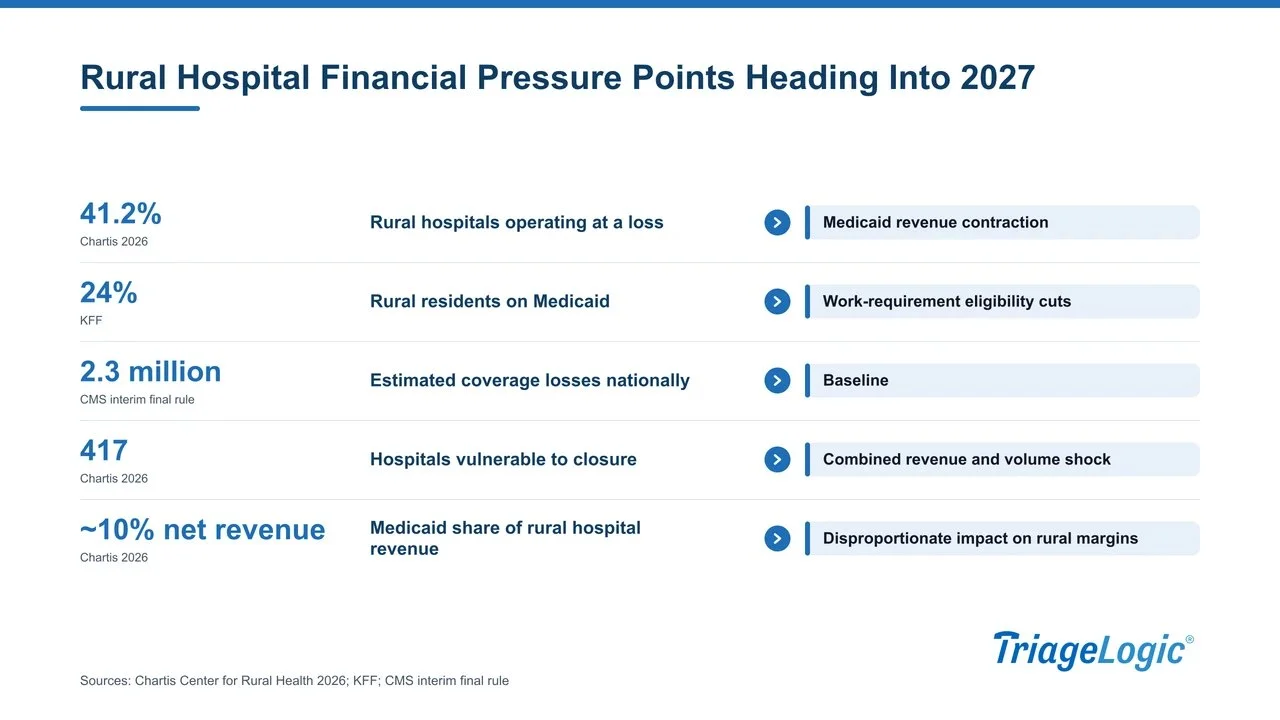
The Chartis Center for Rural Health reports that 41.2 percent of rural hospitals are currently operating in the red. Another 417 are considered vulnerable to closure. Since 2010, 206 rural hospitals have closed or converted away from inpatient care. Medicaid accounts for close to 10 percent of total net revenue for the typical rural hospital.
Any enrollment contraction hits the income statement fast.
Rural residents face steeper barriers to meeting work-reporting requirements than their urban counterparts, according to the Georgetown University Center for Children and Families. That means rural Medicaid rolls could contract faster than the national average suggests.
| Pressure Point | Current Status | 2027 Trigger |
|---|---|---|
| Rural hospitals operating at a loss | 41.2% (Chartis 2026) | Medicaid revenue contraction |
| Rural residents on Medicaid | 24% (KFF) | Work-requirement eligibility cuts |
| Estimated coverage losses nationally | Baseline | 2.3 million (CMS interim final rule) |
| Hospitals vulnerable to closure | 417 (Chartis 2026) | Combined revenue and volume shock |
| Medicaid share of rural hospital revenue | \~10% net revenue (Chartis 2026) | Disproportionate impact on rural margins |
Coverage Loss Redirects Patients to the ER
When Medicaid coverage lapses, patients do not delay care indefinitely. They seek it uninsured at the most expensive access point available. That cost lands on the facility.

According to AHRQ HCUP data, the average treat-and-release ER visit costs $750. For Medicare patients, that figure climbs to $1,040. Rural ERs carry a 37.4 percent Medicare payer mix, the highest of any care setting. Financial exposure from avoidable visits is proportionally largest in exactly the communities facing the most closures.
Consider what happens on January 2, 2027: a parent’s Medicaid card stopped working the day before. At midnight, her child has a high fever and a rash spreading down the arm. She has no way to reach a clinician. She drives to the ER.
A nurse on a 24 hour nurse line, following physician-approved Schmitt-Thompson protocols, could have assessed that call in minutes and guided the family to the right level of care. RHTP funding does not reimburse avoidable ER visits after the fact. Intercepting the call before the visit means the cost never occurs.
How a 24 Hour Nurse Line Maps to RHTP Eligibility
A 24 hour nurse line clears multiple RHTP focus areas simultaneously: telehealth infrastructure, workforce capacity, and unnecessary utilization reduction.
- Telehealth infrastructure: Calls are handled remotely by licensed RNs, satisfying the technology-advancement bucket without bricks-and-mortar expansion.
- Workforce capacity: No overnight FTE additions required. Our nurses extend your team’s clinical reach after hours without accelerating burnout.
- Utilization reduction: Approximately 1 in 6 of our triage calls helps avoid an unnecessary ER visit. Healthcare systems implementing comprehensive triage programs have reported 15 to 25 percent reductions in total ER utilization without increases in adverse outcomes, according to the Annals of Emergency Medicine.
- Evidence-based care: Our nurses follow physician-approved Schmitt-Thompson clinical protocols that create a documented, auditable clinical decision trail, exactly the evidence RHTP progress reports require.
- Accreditation backing: Our URAC Health Contact Center (HCC) accreditation and average 9-minute callback time give program reviewers the quality benchmarks and response-time documentation a rural health grant audit expects.
What protocols alone cannot provide is the clinical judgment a trained RN applies when a refill request surfaces a symptom pattern signaling something more urgent. Protocols structure the call; the nurse reads what lies beneath it.
What Our Digital Front Door Delivers for Rural Operations
Our Digital Front Door combines Nurse Triage On Call with MedMessage Automate to handle clinical calls and patient intake around the clock. No additional staff. No change to your existing phone number.
Patients call the same number they already know. A secure text link arrives immediately, no app required. That link guides structured intake, routing administrative requests to practice staff and clinical calls to your nurses, our nurses, or both. Always on, always covered.
Our registered nurses follow physician-approved Schmitt-Thompson protocols and return calls in about 9 minutes on average, well within URAC’s 30-minute standard. MedMessage Automate diverts 60 to 70 percent of clinical calls away from the front desk from day one.
Physician-developed, nurse-validated intake protocols flagged 100% of patients who needed 911 and 99.4% of patients who needed ER care as urgent. That screening is built on more than 20 years of clinical triage experience, not a generic message service.
For organizations that need triage coverage alone, Nurse Triage On Call is available independently. The full Digital Front Door delivers more:
- Patients reach you through one existing number, with no new technology to learn
- Clinical and administrative requests separate automatically at intake
- RNs on Schmitt-Thompson protocols average a 9-minute callback
- 60 to 70 percent of front-desk clinical calls shift to structured text from day one
- No setup fee, live in as little as 2 weeks to 30 days, and an ROI satisfaction guarantee: if call volume does not drop, we’ll ensure your satisfaction.
The Window to Act Is 2026, Not 2027
Year-one RHTP funds must be obligated and spent by September 30, 2027. Procurement decisions need to happen now, before the fiscal calendar closes.
That deadline is closer than it looks. Standard onboarding takes one 40-minute meeting, and most organizations are live within 30 days. Contracting, budget approval, and internal sign-off all add time, though. Waiting until January 2027 leaves, realistically, six months or fewer to implement, generate utilization data, and compile the documentation RHTP progress reporting requires.
Cost predictability matters here. A 24 hour nurse line through our service runs is set up as a fixed cost, with an auditable range and no hidden variable costs. That line-item clarity is exactly what RHTP administrators need to demonstrate appropriate fund usage. Vague or bundled service costs create friction at reporting time; a clean per-call rate does not.
Our nurses follow physician-approved Schmitt-Thompson protocols on every call. That is what separates us from a generic phone answering service. The utilization record you submit to RHTP reflects genuine clinical activity, not clerical handoffs.
The decisions made this year determine what rural organizations can actually show for their RHTP budget period. See how Digital Front Door works and request a demonstration before the funding deadlines make the decision for you.
Frequently Asked Questions
What is a 24 hour nurse line and how does it differ from a medical answering service?
A 24 hour nurse line connects callers to registered nurses who assess symptoms and provide medically sound guidance using clinical protocols like Schmitt-Thompson. A general answering service takes messages and routes calls without clinical judgment. The distinction matters for RHTP eligibility, which requires evidence-based interventions.
Does a nurse triage line qualify for Rural Health Transformation Program funding?
RHTP’s approved focus areas include technology advancement, workforce development, and evidence-based care innovation. A 24 hour nurse triage line addresses all three and produces the utilization documentation CMS will require in annual progress reports.
How many rural residents are expected to lose Medicaid coverage under the 2027 work requirements?
CMS’s interim final rule estimates 2.3 million people will lose Medicaid enrollment in 2027, according to Healthcare Dive. Rural residents face greater compliance barriers: higher unemployment rates, limited broadband, and poorer average health status. Rural Medicaid rolls may therefore contract faster than the national figure suggests.
What happens to RHC and FQHC telehealth billing after December 31, 2027?
The broader Medicare telehealth flexibilities expire December 31, 2027. RHCs and FQHCs already lost the bundled G2025 billing code October 1, 2026. Each service now requires individual CPT or HCPCS codes with the appropriate modifier and revenue code for non-behavioral telehealth.
How quickly can a rural clinic get a nurse triage line operational?
Onboarding takes a single 40-minute meeting. Most organizations go live within 2-4 weeks. That speed matters for rural organizations that need to show RHTP-eligible expenditures before the September 30, 2027 spending deadline.
Closing Thoughts
Three policy clocks are running down simultaneously. That is the core problem. Each one hits a different part of the operating model.
RHTP year-one funds must be obligated by September 30, 2027. Medicaid work requirements take effect January 1. Medicare telehealth flexibilities end December 31. Miss any one of them and the financial exposure compounds.
Patients who lose coverage will not stop getting sick. They will arrive uninsured at your emergency room, and the cost lands on your balance sheet.
A 24/7 RN triage line built on physician-approved Schmitt-Thompson protocols addresses all three pressures in a single contract. It requires no additional headcount. It qualifies across multiple RHTP eligibility categories. Few investments can do the same.
The window to act is open now. See how Digital Front Door works and schedule a demonstration before the funding deadlines make the decision for you.