Most after-hours patient calls do not require a physician. A 24/7 nurse triage line puts a licensed RN on every call first. In peer-reviewed research published on PubMed Central, an after-hours nurse line resolved 70% of calls with no physician involved for an academic pediatric practice. That single figure reframes the conversation for any organization watching burnout rates and ER utilization climb together.
Round-the-clock RN coverage is not a staffing luxury. It is a structural decision about who absorbs the first wave of patient demand. When the wrong person absorbs it, the downstream consequences are measurable and expensive.
What a 24/7 Nurse Triage Line Actually Does
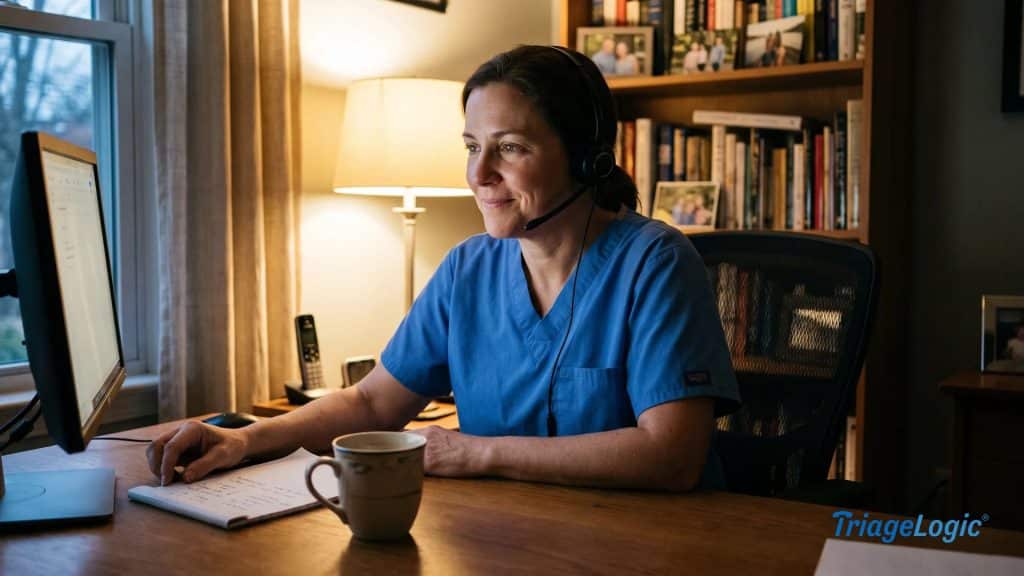
A 24/7 nurse triage line is a clinical service. It is not a call-routing service. Licensed RNs assess symptoms in real time, apply evidence-based protocols, and direct patients to the right level of care. Calls do not default to a physician.
The workflow is clinically rigorous. A patient calls in after hours, and a nurse gathers the presenting situation. Working through physician-approved Schmitt-Thompson protocols, the nurse determines acuity. The recommendation is clear and defensible: monitor at home, visit urgent care, or go to the ER.
That clinical layer is what separates a nurse triage line from the alternatives. An answering service captures a message and waits. A symptom checker asks yes-or-no questions and cannot hear anxiety in a caller’s voice. Neither can weigh clinical context, ask a follow-up question, or apply professional judgment.
Trained RNs can do all three.
Here is what the clinical handoff typically covers:
- Structured symptom assessment using Schmitt-Thompson protocols
- Acuity-based disposition: home care instructions, then scheduled office visit, then urgent care, then ER referral
- Clear documentation of the call and recommendation
- Escalation to an on-call physician only when the clinical picture requires it
- Follow-up guidance so patients know what to watch for overnight
The After-Hours Call Problem Physicians Cannot Ignore
Sixty-three percent of after-hours patient calls arrive on weekends or holidays, according to the Journal of General Internal Medicine. This concentrated volume lands exactly when physicians are least available.
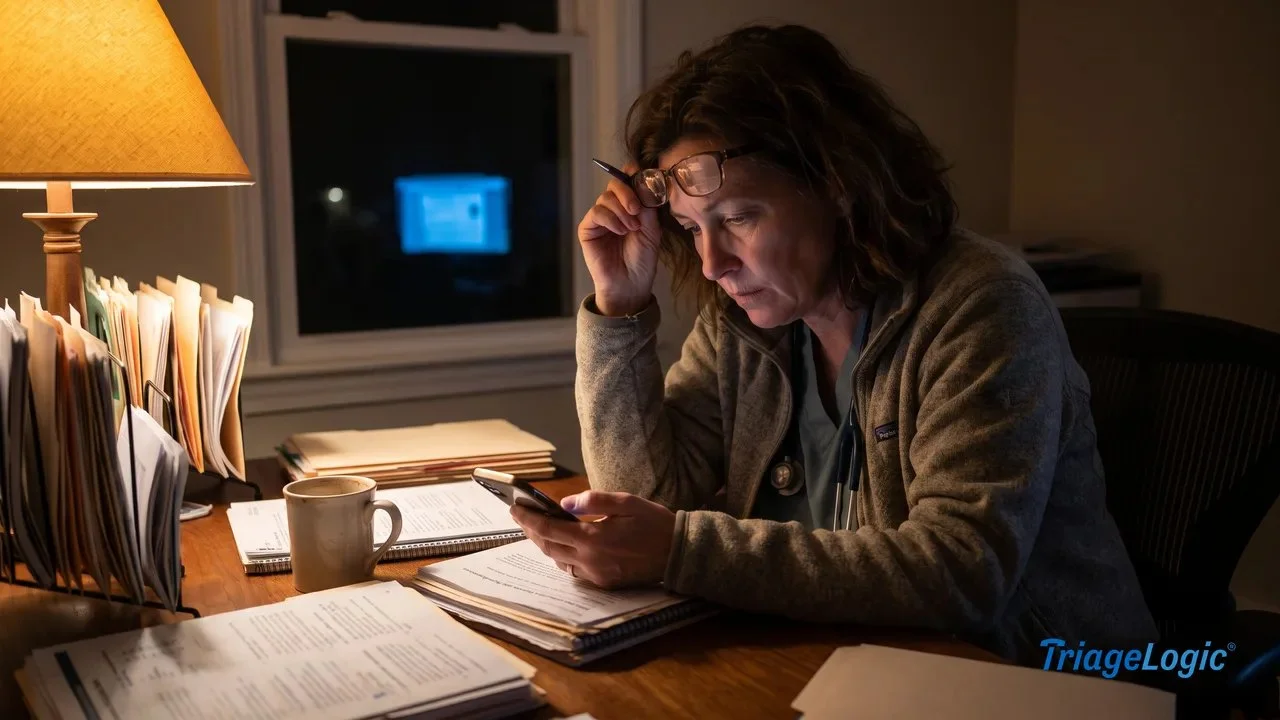
Picture a Saturday night on call for an internist covering a mid-size primary care group. Twelve calls come in between 9 p.m. and 2 a.m. One patient asks whether her new beta-blocker is causing dizziness. Another wonders if a child’s rash needs attention before Monday.
A third has already called once. None are true emergencies, but each requires a clinician to stop, assess, and respond. By Sunday morning, she has lost sleep and most of the day’s productivity.
That cumulative weight erodes patience for the job in ways that are hard to recover. The American Medical Association reported that 41.9% of U.S. physicians showed at least one burnout symptom in 2025. Replacing a physician who leaves costs a practice between $500,000 and more than $1 million, per AMA estimates. Repeated overnight interruptions accelerate that trajectory.
A staffed 24/7 nurse triage line changes the math. Nurses working from physician-approved Schmitt-Thompson clinical protocols handle the volume and sort by acuity. Calls that need a physician reach one. Nurses resolve the rest directly.
To see how that structure works operationally, download the Nurse Triage On Call guide.
How Clinical Protocols Make Nurse Decisions Defensible
Schmitt-Thompson clinical protocols back every disposition a triage nurse reaches. These are physician-approved, evidence-based decision trees. They cover adult and pediatric presentations across hundreds of symptom categories.
Our service operates under URAC Health Contact Center (HCC) accreditation. That means it is a credentialed clinical operation held to defined standards. It is not an administrative workaround.
Schmitt-Thompson protocols matter legally and clinically. Each disposition is traceable to a specific protocol pathway. If a call is ever questioned, the nurse’s reasoning is defensible at every step.
Compare that to a generic answering service reading from a script. There is no clinical backbone. There is no decision logic. There is no documented rationale.
The protocols cover a wide range of presentations. Even so, a nurse’s skill lies in knowing when a caller’s words alone are not the full picture. A patient who says “I’m probably fine” while breathing audibly harder than normal carries a different risk profile than the words suggest. A parent whose voice tightens when describing a rash may be signaling something no decision tree catches on its own.
Technology supports the process. Clinical judgment drives it.
Explore how Schmitt-Thompson protocols structure safe, consistent triage decisions across common and complex presentations alike.
The ER Diversion Effect: What the Numbers Show
Unnecessary ER visits cost the U.S. healthcare system an estimated $4.4 billion annually, according to AHRQ. Trained nurse triage is one of the few interventions with documented, direct impact on that figure. When a patient can reach a clinical voice at 11 p.m., the default trip to the ER becomes a genuine last resort rather than the only option.
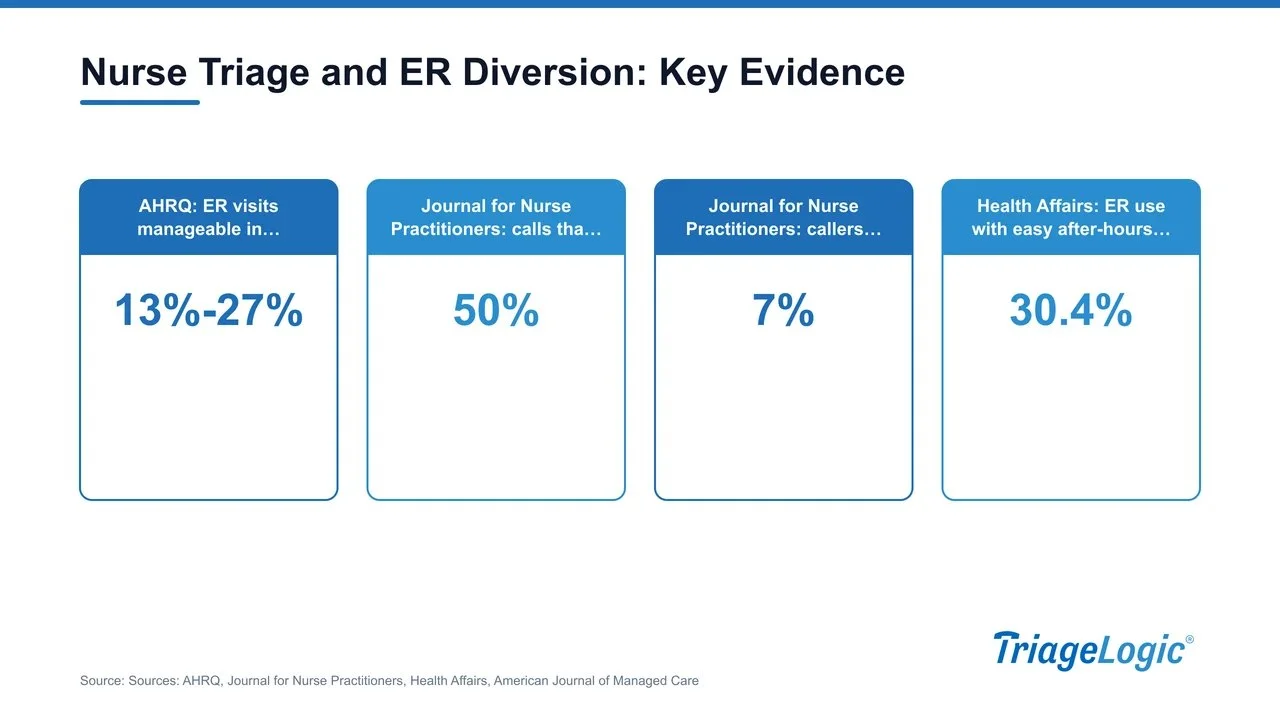
The evidence on diversion is consistent across sources:
- AHRQ estimates that 13% to 27% of U.S. ER visits could be handled in lower-acuity settings. Most patients calling after hours need reassurance and a care plan, not an ambulance.
- A study published in the Journal for Nurse Practitioners00546-7/abstract) tracked an after-hours call program. It found that 50% of calls averted an ER visit entirely. Only 7% of callers were ultimately referred to the ER. Access alone shifts behavior.
- Health Affairs data show that patients who could easily reach a clinician after hours visited the ER at a rate of 30.4%. Among those who struggled to get through, that rate rose to 37.7%. The difference is stark.
Across our own call volume, approximately 1 in 6 triage calls helps avoid an unnecessary ER visit. You can see TriageLogic patient outcomes data that reflect this effect directly.
The return on that investment holds up financially. A health plan study published in the American Journal of Managed Care found greater than 90% user satisfaction. It also estimated a return of approximately $1.70 for every $1 invested in nurse triage.
| Evidence Source | Finding | Notes |
|---|---|---|
| AHRQ | 13%-27% of ER visits avoidable | Could be managed in lower-acuity settings |
| Journal for Nurse Practitioners | 50% of calls averted ER visit; 7% referred to ER | After-hours call program data |
| TriageLogic internal data | 1 in 6 calls avoids unnecessary ER visit | Across our nurse triage call volume |
| Health Affairs | 30.4% vs. 37.7% ER use | Easy vs. difficult after-hours access |
| American Journal of Managed Care | $1.70 ROI per $1 invested | Health plan study; 90% user satisfaction |
Operational Realities: Response Time, Coverage, and Compliance
A 24/7 nurse triage line is only as reliable as its response time and compliance posture. Those two factors are where the gap between credentialed vendors and basic answering services shows up most clearly, and most expensively.
Speed matters. Our nurses return calls in about 9 minutes on average, well within the URAC 30-minute standard for health contact centers. An answering service that logs a message and promises a callback “soon” cannot offer that accountability. A worried patient at 11 p.m. is not inclined to wait.
Scale and continuity matter just as much. Our physician-led network includes more than 22,000 physicians and covers over 42.5 million lives. Coverage does not hinge on one nurse finishing a long call or one site losing power.
Compliance is non-negotiable. Nurse triage call centers operating on behalf of covered entities are HIPAA Business Associates. They must enter signed Business Associate Agreements. Call recordings, message handling, and clinical documentation all carry compliance obligations.
Gaps in any of those areas create defensibility problems.
For practices that also want to pull routine calls away from daytime front-desk staff, MedMessage Automate handles patient message intake around the clock via physician-designed secure-text and digital-form pathways. It shifts roughly 65% of routine front-desk calls to text and saves 3-7 minutes per message, with EMR/EHR integration, HIPAA compliance, and SOC 2 Type II attestation.
Key operational checkpoints to confirm with any vendor:
- Average nurse callback time, tracked against a defined standard
- Geographic and staffing redundancy so no single site failure breaks coverage
- Signed HIPAA Business Associate Agreement, in place before go-live
- Documented protocols (such as Schmitt-Thompson) governing every clinical call
- Secure handling of call recordings and patient messages with auditable records
What to Look for When Evaluating a 24/7 Nurse Triage Vendor
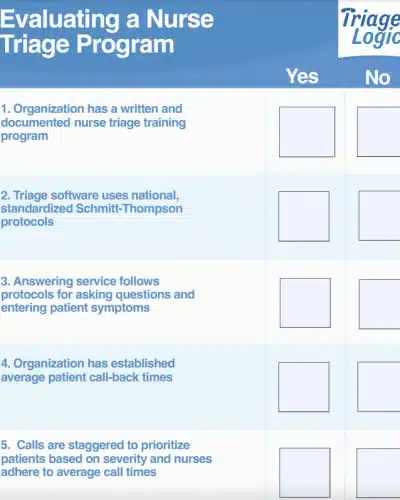
Not every service using the phrase “nurse triage” employs licensed RNs following clinical protocols. Some route calls through non-clinical operators who escalate based on scripts alone. The evaluation checklist is short but non-negotiable.
Start with licensure and supervision. A credible vendor employs licensed RNs and operates under physician oversight, not just a medical director listed on a website. Ask specifically how clinical decisions are reviewed, how edge cases are escalated, and what happens when a nurse is uncertain. Vague answers signal a deeper structural problem.
Protocol specificity matters just as much. Vendors using named, evidence-based frameworks such as Schmitt-Thompson clinical protocols offer a documented, defensible standard of care. A generic script is not the same thing. The difference becomes apparent when a caller presents with ambiguous or layered symptoms that require judgment, not pattern-matching.
When you sit down for vendor demos, download the medical call center evaluation checklist so nothing gets buried in the conversation. Confirm each of the following:
- RN licensure and physician-led clinical supervision with a clear escalation structure
- Named clinical protocols (Schmitt-Thompson or a peer-reviewed equivalent), not proprietary scripts
- URAC Health Contact Center (HCC) accreditation, signaling independent quality review
- HIPAA Business Associate Agreement availability and SOC 2 Type II compliance documentation
- Documented average response time benchmarked against the URAC 30-minute standard
- ER diversion reporting and outcomes data you can actually review
We built our 24/7 nurse triage line, physician-led since our founding in 2006, to meet every one of these criteria. Practices that cannot staff a triage desk internally deserve a vendor that can show its work, not just assert quality.
Frequently Asked Questions
What is a 24/7 nurse triage line?
A 24/7 nurse triage line is staffed by licensed registered nurses. They assess patient symptoms by phone at any hour. Using evidence-based clinical protocols, they direct callers to the right level of care, from home self-care to the emergency room.
How much of after-hours call volume can a nurse triage line resolve without a physician?
In peer-reviewed research published on PubMed Central, after-hours nurse triage lines handled 70% of calls without any physician involvement. That high-volume filtering is precisely what reduces unnecessary interruptions to on-call physicians.
What clinical protocols do triage nurses use?
Most credentialed nurse triage services, including ours, use Schmitt-Thompson protocols. These are physician-approved, evidence-based decision trees that guide nurses through symptom assessment and disposition for both adult and pediatric callers.
Does a nurse triage call center need to be HIPAA compliant?
Yes. Nurse triage call centers operating on behalf of covered healthcare entities are HIPAA Business Associates. They must sign a Business Associate Agreement and maintain appropriate safeguards. All calls must be documented in a compliant manner.
How fast should a nurse triage service respond to after-hours calls?
URAC’s Health Contact Center standard sets a 30-minute callback benchmark. Our nurses average approximately 9 minutes, a meaningful margin that matters when patients are deciding whether to head to the ER.
Closing Thoughts
Physicians spending Saturday nights fielding non-urgent symptom calls are less available, and less effective, during Monday’s clinic hours. That cost is real, even when it goes unmeasured.
A nurse triage service built on Schmitt-Thompson protocols and staffed by experienced RNs offers patients a clinical voice at any hour. Operating under URAC Health Contact Center accreditation, it also protects the physician time your practice depends on.
Ready to see what continuous nurse coverage looks like in practice? Contact us to schedule a demo. To evaluate what a structured triage program could mean for your patient population and on-call team, explore the Nurse Triage Protocols guide. It walks through the clinical standards and operational decisions worth examining before you build or outsource.
Sources
- Journal of General Internal Medicine (2024)
- PubMed Central
- American Journal of Managed Care
- AHRQ (Agency for Healthcare Research and Quality)
- Health Affairs
- Journal for Nurse Practitioners
- Schmitt-Thompson Clinical Content 2023 Nurse Triage Benchmarking Report (2023)
- URAC
- HIPAA Journal
- American Medical Association (2026)
- American Medical Association
- American Nurse Journal (2023)