

How Rural Hospitals Can Turn RHTP Dollars Into Operational Reality
By TriageLogic
Most administrators scanning the Rural Health Transformation Program expect a straightforward federal grant. Apply, receive funds, deploy technology. That mental model will cost them. The real opportunity runs through state Medicaid agencies.
They receive CMS dollars first. They shape distribution terms before most providers ever see an announcement. Facilities that wait for a simple portal to open will find the meaningful decisions already made without them.
The hospitals positioned to benefit in 2026 are documenting eligible investments now and building measurable outcome baselines. They are engaging state agencies while distribution models are still being written. That is not bureaucratic box-checking. It is the difference between capturing funds that move operational capacity forward and watching a well-funded program pass by.
What the RHTP Actually Is
The Rural Health Transformation Program is a multi-billion-dollar, five-year federal grant initiative. Congress established it through the One Big Beautiful Bill Act on July 4, 2025. Funds flow from CMS to state Medicaid agencies first. Hospitals and clinics are not the initial recipients.
Miss that structure and you will draft applications for a process that does not exist.
CMS distributes allocations through the newly created Office of Rural Health Transformation. State shares vary based on rural population and Medicaid enrollment. Each state then builds its own sub-grant and aggregator-contract framework. The rules your facility plays by are largely written in your state capital, not in Washington.
States cap direct provider payments at a defined percentage of annual allocations. Most RHTP dollars move through infrastructure investments, workforce pipelines, and care-model pilots first. Upstream work gets funded before individual clinical operations see any checks.
The financial pressure on rural providers is already severe. According to the 2026 Chartis State of Rural Health report, 46% of rural hospitals operate at a negative margin. Chartis identifies another 432 as vulnerable to closure. For context, according to North Carolina Health News, Medicaid spent $19 billion on rural hospitals in all of 2024. The RHTP offsets roughly 37% of estimated rural Medicaid revenue losses created by other provisions in the same legislation, so the offset is real but incomplete.
Knowing where your state stands in its framework design matters. Which aggregator models it favors will determine whether your organization captures funding or watches it flow past.
- CMS allocates funds to state Medicaid agencies, averaging $200 million per state (range: $147 million to $281 million).
- States design their own sub-grant frameworks and aggregator contracts, so program rules vary by state.
- States cap direct provider payments at a defined percentage of each state’s annual allocation.
- 46% of rural hospitals currently operate at a negative margin, with 432 identified as closure risks.
- The RHTP meaningfully offsets a portion of the rural Medicaid revenue losses created by the same legislation.
- Most RHTP dollars fund infrastructure, workforce, and care-model development before reaching individual providers.
The Eligible Use Categories That Matter Most to Operators
Telehealth infrastructure, IT modernization, and innovative care models are all RHTP-eligible. So is workforce recruitment and retention. The best technology investments satisfy more than one category at once. A nurse triage platform, for example, can address workforce sustainability, virtual care access, and clinical documentation standards simultaneously, making it one of the more efficient uses of program funds.
Workforce sustainability is where rural health transformation program hospitals often feel the most immediate pressure. Rural areas average 5.1 primary care physicians per 10,000 residents compared to 8.0 in urban areas, and more than 90% of rural counties face primary care shortages. Rural regions hold 63.1% of all primary care health professional shortage areas, according to the Rural Health Information Hub, and the HRSA Bureau of Health Workforce projects a 39% shortage of primary care physicians in nonmetro areas by 2038. According to the Commonwealth Fund, 43 million rural residents lack adequate primary care access, and 38% of rural adults turn to the emergency room for concerns a primary care office could handle. Additionally, 68% of nurses report burnout, and average RN turnover reached 16.4% in 2024. The Bureau of Labor Statistics expects about 189,100 RN openings each year through 2034, while according to NurseJournal.org, more than 1 million RNs are expected to retire by 2030. Investments that reduce repetitive call volume and support structured intake directly support the people who remain.
Scoring also favors applicants in states with telehealth payment policies covering multiple modalities and streamlined clinician licensing. Your state’s policy environment actively shapes your application’s competitive position.
Vague claims about “modernizing care” score poorly. Specific, documented outcomes grounded in named clinical standards score well. For nurse triage investments, see how Schmitt-Thompson protocols support documented, measurable clinical workforce standards.
- Telehealth infrastructure includes after-hours nurse triage platforms, secure patient messaging, and remote monitoring connectivity.
- Workforce investments cover recruitment incentives, training programs, and tools that reduce clinician and staff burnout.
- IT modernization encompasses EMR/EHR integration, cybersecurity hardening, and interoperability upgrades.
- Innovative care models reward approaches that change how care is delivered, not just who delivers it.
- Applicants can and should demonstrate how a single investment serves multiple eligible categories.
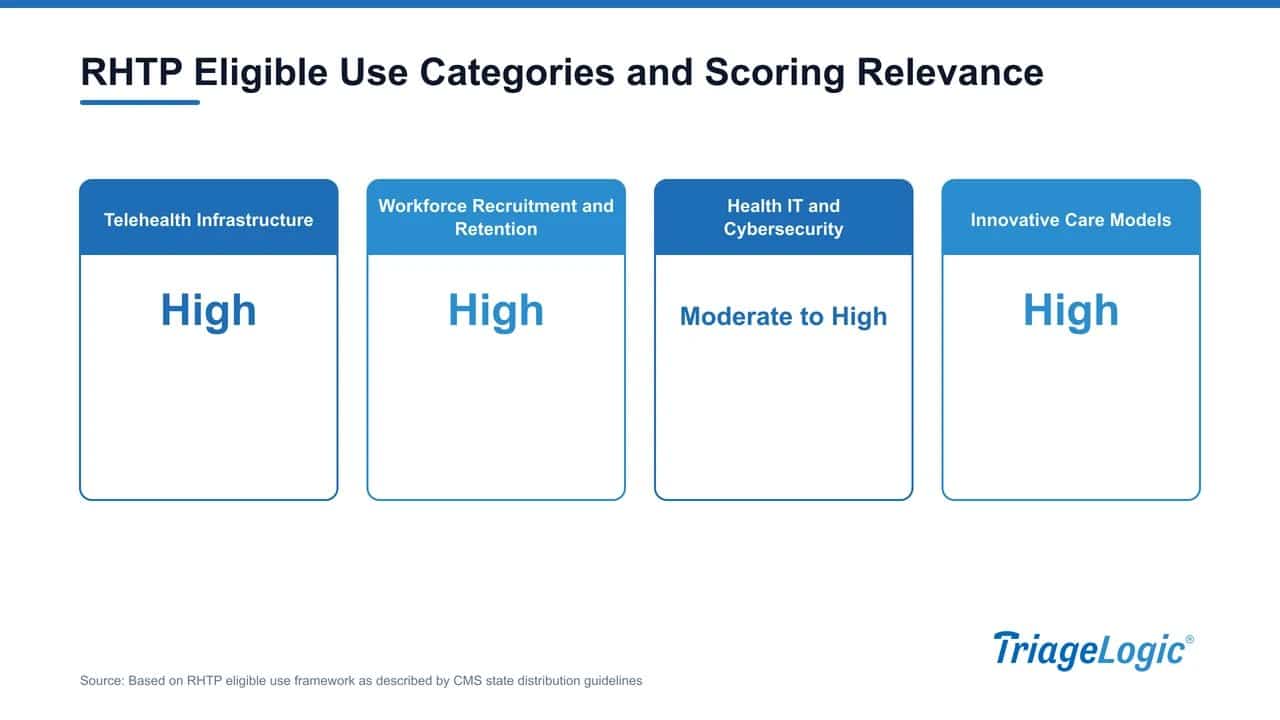
| Eligible Category | Example Technology Investment | RHTP Scoring Relevance |
|---|---|---|
| Telehealth infrastructure | Nurse triage on call, patient message intake | High. States with multi-modality payment policies score this category favorably. |
| Workforce recruitment and retention | Triage platforms that reduce call burden on clinical staff. Directly addresses rural physician and nurse shortages. | High |
| Health IT and cybersecurity | EMR integration, HIPAA-compliant messaging, SOC 2-attested systems | Moderate to high; supports interoperability requirements |
| Innovative care models | Structured clinical intake that shifts routine calls away from the ER | High; demonstrates measurable care delivery change |
The Fiscal Reality Behind the Funding Window
The RHTP is significant, but providers who treat it as a rescue package will be disappointed. It covers roughly a third of the Medicaid revenue losses the same bill creates. The math works only if facilities deploy funds where they generate measurable operational returns.

The underlying financial picture is stark. 46% of rural hospitals are already operating in the red, according to the 2026 Chartis State of Rural Health report. The 2% Medicare sequestration alone costs rural hospitals hundreds of millions of dollars in 2025. That pressure has contributed to thousands of jobs lost and scores of rural hospital closures between 2005 and 2024.
The RHTP does not reverse those pressures. It creates a targeted window to invest before margins deteriorate further. Use it deliberately.
Consider a 75-bed critical-access hospital running a negative operating margin. Deploying a single eligible after-hours nurse triage service can satisfy both the workforce-reporting and virtual-care-utilization requirements CMS will expect. One line item. Two reporting categories covered. In one documented case reported by Medical Economics, a specialty practice shifted 75% of after-hours calls to nurse coverage, meaningfully reducing overnight demand on physicians.
What that scenario requires is documentation from day one. Teams will need to review outcome data that supports the measurable reporting CMS and states will require before contracts are signed.
How Outsourced Nurse Triage Checks Multiple RHTP Boxes at Once
Telehealth-enabled nurse triage is an RHTP-eligible use. It addresses workforce sustainability, virtual care access, and avoidable ER visit reduction at the same time. Those are three of the metrics states will use to score and renew provider sub-grants.
The cost math is hard to ignore. A low-acuity ER visit can cost well over a thousand dollars. Urgent care runs $178, according to UnitedHealth Group research. Approximately 1 in 6 triage calls through our service helps avoid an unnecessary ER visit.
Outsourced nurse triage addresses workforce pressure without adding headcount. After-hours call volume shifts off your clinical staff and onto our nurses. They follow physician-approved Schmitt-Thompson clinical protocols and return calls in about 9 minutes on average, well within URAC’s 30-minute standard. Founded in 2006, our physician-led network covers more than 42.5 million lives across more than 22,000 physicians.
We hold URAC Health Contact Center (HCC) accreditation, a credential that signals structured oversight to grant reviewers rather than improvised coverage.
Technology supports the process, but clinical judgment drives every decision. Our nurses hear what an algorithm cannot.
Daytime operations benefit as well. MedMessage Automate, our automated patient message-intake product, uses physician-designed secure-text and digital-form pathways. These are structured clinical guardrails, not a generic chatbot. The result: roughly 65% of routine front-desk calls shift to text, saving 3-7 minutes per message.
It integrates directly with EMR/EHR systems and carries HIPAA compliance with SOC 2 Type II attestation, positioning it within the IT modernization category that RHTP sub-grants also fund.
A Step-by-Step Path From CMS Award to Provider Contract
Rural hospitals and clinics cannot apply to CMS directly. They can, however, take concrete steps now to position for state sub-grants and aggregator contracts before distribution models are locked in. States are actively designing their provider-facing programs in 2026. Early documentation gives rural health transformation program hospitals a real priority advantage.
- Identify your state’s RHTP point of contact and rural health office. Both will influence distribution rules, and their timelines may differ.
- Request or attend state stakeholder engagement sessions in 2026 while distribution models are still being written. This is when provider input actually shapes criteria.
- Prepare a short eligible-investment proposal that maps specific technology purchases to RHTP use categories and includes baseline metrics: ER visit volume, after-hours call volume, nurse turnover rate.
- Document measurable outcomes from any current nurse triage service, including call response times, ER avoidance rates, and after-hours coverage gaps addressed. States will treat this as workforce sustainability evidence.
- If you have not yet evaluated a nurse triage vendor, use this window. Assess nurse triage vendors against the clinical and compliance criteria states will scrutinize before your proposal is finalized.
What Strong RHTP Documentation Actually Looks Like
States will award sub-grants and renew contracts based on measurable outcomes. Build your documentation framework before you deploy technology, not after. Getting the metrics right from day one separates a renewal-ready program from one that scrambles to reconstruct data at reporting time.
The reporting categories most relevant to rural health transformation program hospitals map directly to operational triage metrics. Track ER diversion rate, average nurse response time against the URAC benchmark, after-hours call volume handled without additional staffing, and patient message resolution time. Response time speaks to access. Diversion rate speaks to patient outcomes. Message resolution time speaks to workforce sustainability.
Consider a rural clinic that documents a meaningful drop in avoidable ER visits and a reduction in on-call physician burden, plus roughly 65% of routine patient messages resolved through automated structured intake. That single year of data touches three RHTP reporting categories at once: virtual care access, IT modernization, and workforce capacity.
Our nurses follow physician-approved Schmitt-Thompson protocols for every clinical judgment call. MedMessage Automate handles the volume that would otherwise drain front-desk staff. Neither piece works as well without the other.
HIPAA compliance and SOC 2 Type II attestation are baseline requirements for any tool feeding into CMS and state reporting chains. We arrive with that infrastructure already in place.
Download the Nurse Triage On Call overview to see how after-hours coverage supports CMS-reportable outcomes before your next reporting cycle.
Frequently Asked Questions
Can rural hospitals apply directly to CMS for RHTP funds?
No. CMS distributes RHTP allocations to state Medicaid agencies, which then design their own sub-grant and aggregator-contract programs. Rural hospitals and clinics must engage their state agencies to secure access to those funds.
Is outsourced nurse triage an eligible use under the RHTP?
Yes. Telehealth-enabled nurse triage falls under virtual care access and workforce sustainability, two RHTP-eligible use categories. It can also satisfy IT modernization requirements when paired with HIPAA-compliant message intake tools like MedMessage Automate.
What metrics should a rural hospital track to support an RHTP sub-grant application?
Start with ER visit diversion rate, after-hours call volume handled without additional FTEs, average nurse response time versus the URAC 30-minute standard, and patient message resolution time. These map directly to the workforce and virtual care categories states will evaluate.
How quickly can an outsourced nurse triage service be deployed?
TriageLogic can be operational in weeks, not months. That speed makes it one of the fastest ways for a rural provider to build documented, measurable telehealth outcomes. Getting there before a state’s distribution model is finalized is a real competitive advantage.
Does RHTP funding offset the Medicaid cuts in the same legislation?
Only partially. KFF analysis puts the $50 billion RHTP at roughly 37% of the estimated $137 billion in rural Medicaid revenue losses. Those losses accumulate over 10 years under the One Big Beautiful Bill Act.
Closing Thoughts
The providers who shape Rural Health Transformation Program funding are not the ones who submit the strongest grant applications in 2028. They are the ones who showed up at state agency planning tables in 2026, with qualifying technology already running and outcome data already accumulating. Waiting is a distribution decision made by someone else on your behalf.
Our URAC Health Contact Center-accredited nurse triage service is built on Schmitt-Thompson clinical protocols. It satisfies multiple RHTP eligible-use categories from day one and generates the structured utilization data your state will want to see. If you are ready to map your current operations to qualifying investments and build a documentation framework before the window narrows, schedule time with a TriageLogic advisor.
We will start where your operations actually are.
To map this to your operation, reach out to our team.
Sources