By Charu Raheja, PhD, Cofounder and CEO of TriageLogic
Most discussions about rural health care focus on funding. Yet in practice, rural health transformation succeeds or stalls based on how well systems execute.
After years of watching programs move from planning to implementation, I’ve come to a different conclusion. The primary issue is not funding alone—it is how execution is designed, integrated, and measured.
Across multiple initiatives, the same pattern repeats. Funding is secured, technology is selected, and pilots are launched, but access does not meaningfully improve in the way leaders expect.
Many of the challenges we talk about—patient confusion, workflow friction, and the limits of technology—are not isolated issues. They are symptoms of a deeper execution problem.
This is what I think of as the rural healthcare execution gap: the distance between well‑intended plans and what patients and staff actually experience in practice.
Rural health care transformation does not fail for lack of effort or intent. It fails when execution is not designed around real‑world care delivery.
The Execution Gap Beneath Well-Intended Programs
What undermines many rural health initiatives is not a single flaw, but fragmentation.
- Access is treated as a front-door problem.
- Care navigation is approached as a clinical decision-making issue.
- Workforce challenges are framed as staffing shortages.
- Measurement is handled as a reporting function.
Each of these areas may be addressed thoughtfully, but they are rarely designed together.
In rural settings, this fragmentation is particularly difficult to absorb. Smaller teams, limited redundancy, and geographic distance amplify even minor design gaps. When execution is not integrated, programs that appear strong in planning often struggle under the weight of real-world complexity.
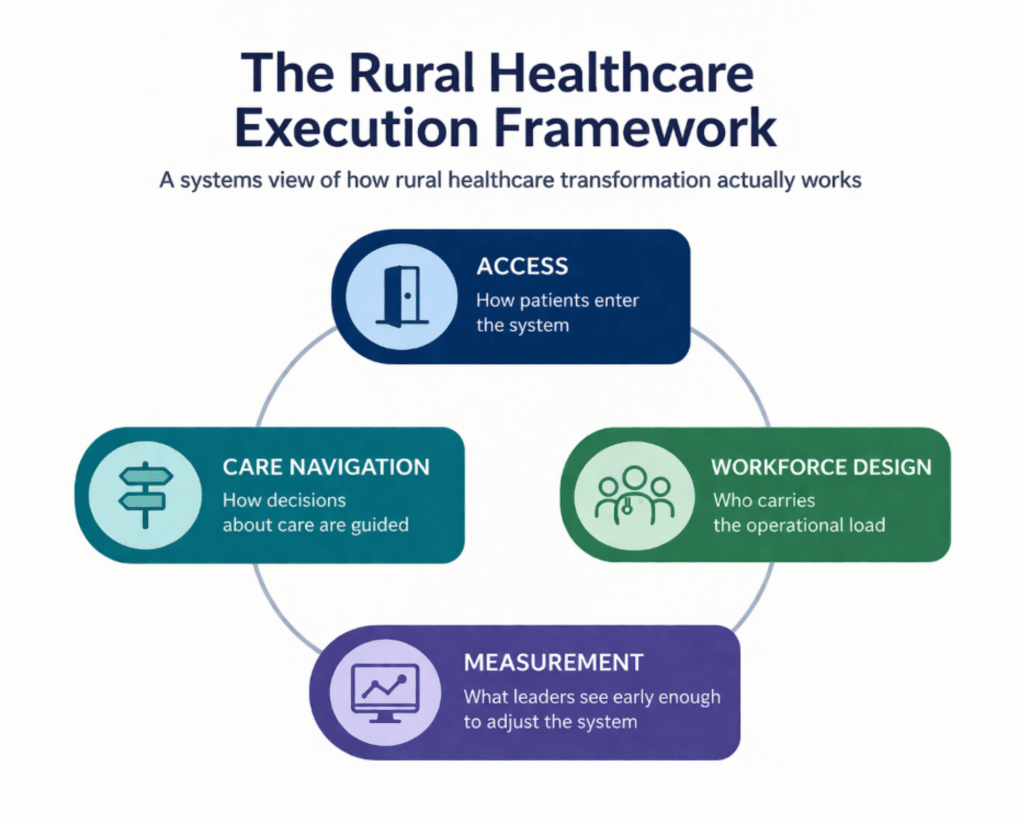
The Rural Healthcare Execution Framework
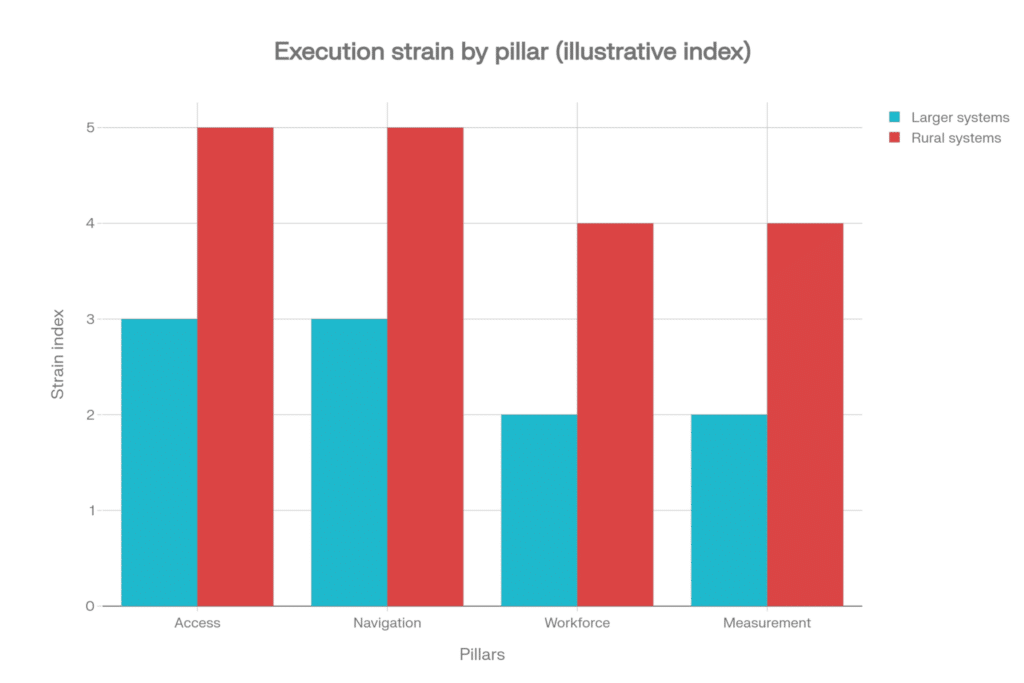
Rural systems experience higher execution strain across all four pillars, making fragmentation visible earlier than in larger systems (illustrative index).
In my work, I’ve found that rural health care succeeds or stalls based on how four operational pillars work together: access, care navigation, workforce design, and measurement.
- Access: How patients enter the system and seek help when care begins
- Care Navigation: How decisions about care are guided and care is routed
- Workforce Design: How operational and cognitive responsibilities are distributed across the team
- Measurement: What leaders see early enough to adjust the system before problems harden into outcomes
When these pillars are designed separately, systems fragment. When they are designed together, transformation becomes possible.
Where Execution Quietly Breaks Down
Execution challenges rarely appear where leaders expect them. These are system optimization failures long before they show up as formal quality or financial issues.
They emerge when technology is introduced before workflows are clearly defined, when new programs add steps without reducing cognitive load, and when metrics lag operational reality by months.
In rural environments, staff are often already operating at capacity. When systems introduce ambiguity—such as unclear intake pathways, inconsistent decision support, or fragmented documentation—friction builds quickly.
Patients experience this as confusion or delay.
Staff experience it as interruption and burnout.
Leadership often sees it only after momentum has already slowed.
Access Is Not a Moment—It Is a Journey
One of the most common execution mistakes is treating access as a single event.
In reality, access is a sequence that begins the moment a patient seeks help and continues through how their needs are understood, how decisions are guided, how care is routed, and how follow-up occurs.
In many rural communities, the first breakdown is simple but critical: Patients cannot reach the system in a timely way. Calls go unanswered, appointments are delayed, and patients may abandon attempts to seek care altogether.
By the time these issues appear in formal metrics, the underlying strain has often been present for months.
Access is not simply a scheduling function. It is the beginning of a clinical and operational journey that must connect seamlessly to the rest of the system.
Why Rural Systems Expose Execution Failures First
Rural health care does not create execution problems—it exposes them earlier.
Because rural systems operate with smaller teams, fewer buffers, and limited redundancy, they cannot absorb fragmentation the way larger systems sometimes can. When workflows are unclear or systems are disconnected, the impact is immediate.
For this reason, rural health care offers a valuable lens into how medical systems actually function and their effectiveness. The same execution patterns appear in larger networks; rural environments simply make them visible sooner. It reveals where execution breaks down before those issues become visible elsewhere.
When Execution Is Designed to Work
When rural health initiatives succeed, the difference is rarely funding alone. It is execution discipline.
Effective systems are designed from the perspective of patient and staff experience. They reduce ambiguity before introducing new tools and focus on monitoring early operational signals rather than relying solely on long-term outcomes.
Leaders in these environments tend to ask different questions. They look for where friction appears first, how patients actually move through the system, and what would fail under increased demand.
These questions shift transformation from theory into practice.
Why This Matters Now
New rural health initiatives create meaningful opportunities, but they also raise the stakes.
Additional funding without alignment in execution can increase complexity rather than improve outcomes. The critical question is not how much funding exists, but whether execution is intentionally designed to optimize how patients and staff move through care.
Funding creates the possibility of change. Disciplined execution determines whether patients ever feel it.
The views expressed here reflect system-level observations from working across rural health care delivery and are intended to inform discussion, not advocate for any specific solution.
About TriageLogic
TriageLogic is a URAC-accredited, physician-led provider of top-quality nurse telehealth technology, remote patient monitoring, and medical call center solutions. Founded in 2006, the TriageLogic Group now serves more than 22,000 physicians and covers over 42.5 million lives nationwide.