
The Role of Documentation in Modern Hospital Triage
Imagine a patient calling after hours with chest discomfort that “comes and goes.” The triage nurse asks a few questions, gives guidance, and documents the interaction as best they can before moving on to the next call. The next morning, the primary provider reviews the note but sees that key details are missing, the urgency isn’t clear, and the rationale for the disposition isn’t fully documented. Now the clinical team must interpret the call with limited information, and the hospital must rely on incomplete records if the patient’s condition worsens.
For many hospital administrators, this is a familiar challenge. Telephone triage has real implications for patient safety, regulatory compliance, and liability. Every patient interaction must be documented appropriately so that providers know how to respond and they can clearly explain and defend their decisions.
Triage calls often involve symptoms, medication questions, or follow-up needs that must be captured accurately so that clinical teams receive the right information. Yet many hospitals still rely on manual processes that are unable to handle high call volumes or the current requirements for standardized recordkeeping.
How Documentation Gaps Increase Liability Risk
It’s safe to say that clinicians already spend a great deal of time managing patient data. Why not use software that makes that process easier? Gaps in documentation can be a heavy liability for a hospital system, especially if they lead to negative health outcomes.
When triage nurses rely on free-text notes or inconsistent workflow patterns, essential details can be missed, delayed, or recorded differently across shifts. Over time, these gaps make it difficult to confirm what guidance was provided and why certain clinical decisions were made.
Common issues in manual or outdated triage systems include:
- Missing or incomplete symptom descriptions.
- Notes that vary widely by staff member.
- Lack of rationale for dispositions or escalations.
- Untracked messages or unclear routing.
- Delayed documentation after high-volume periods.
In the event of an audit, complaint, or adverse outcome, hospitals need a clear, time-stamped record of what happened during patient encounters.
The Connection Between Documentation and Patient Safety
Documentation is important because it protects patients as much as the hospital. The information that triage nurses record directly influences clinical decision-making, from how quickly patients are contacted to whether their requests are identified and escalated as urgent.
When documentation is incomplete or inconsistent, it can lead to delays in addressing concerning symptoms, create confusion among care teams, contribute to inaccurate urgency assessments, and even result in patients being directed to the wrong level of care. Over time, these gaps disrupt continuity between call centers, triage nurses, and providers, making it harder for hospitals to deliver safe, coordinated, and timely care.
Using standardized and complete documentation, nurses are able to recognize emerging issues, escalate requests appropriately, and reduce miscommunication with other team members. Telephone triage serves as a safety intervention so that patients receive clear, consistent guidance regardless of who takes their call.
Why Manual Documentation Struggles to Keep Up
Many hospitals still use systems of documentation that rely heavily on individual judgment — think handwritten notes, open-ended text fields, or custom workflows developed over time. While these approaches may have worked for a certain level of call volume, they may start to struggle when that volume increases.
Manual documentation falls short because:
- High call volume increases the chance of missed information.
- Individual documentation styles can vary widely.
- Notes based on memory are highly subjective.
- Staff turnover disrupts consistency and training.
- Nurses must switch between multiple systems or templates.
- Hospitals lack visibility into call patterns and patient risks.
As healthcare systems face staffing shortages and growing patient demand, administrators need triage documentation that can scale reliably and withstand clinical, legal, and regulatory scrutiny.
How Triage Software Documentation Reduces Risk
This is where triage software documentation delivers measurable value. Modern nurse triage software replaces variable documentation with structured recordkeeping that is designed to support consistency and quality oversight.
Key advantages include:
- Protocol-based workflows that establish symptom urgency.
- Standardized procedures that promote full symptom capture.
- Time-stamped records that justify nurse guidance over the phone.
- HIPAA-compliant documentation for clear auditing.
- Easy data retrieval for incident reviews and quality assurance.
Improving Patient Outcomes Through Better Documentation
Better documentation leads to better provider decisions because triage software provides structured fields and evidence-based protocols. Patient outcomes become more predictable and more aligned with clinical expectations.
As a result, practices see more accurate dispositions, fewer unnecessary ER referrals, and quicker escalation when symptoms require urgent attention. Consistent records strengthen coordination across departments, support clearer follow-up instructions, and improve continuity of care for higher patient satisfaction and trust.
How Administrators Should Evaluate Triage Software Documentation
Selecting the right triage solution requires evaluating more than basic functionality. Hospitals need to verify that their chosen system offers tools for meeting compliance, data security, readability, and auditing requirements.
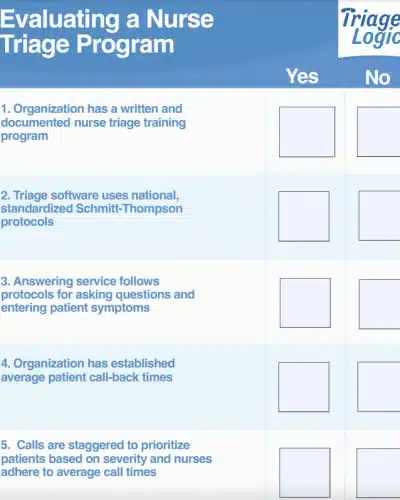
Documentation Evaluation Checklist
Ask these questions when evaluating nurse triage software.
- Does it use evidence-based protocols?
- Are documentation fields structured, not simply free-text?
- Are all calls time-stamped with clear dispositions?
- Can documentation be exported easily into EHRs (or at least be shared with them)?
- Does it scale during high-volume periods?
- Is the audit trail complete and accessible?
- Are reporting and analytics included?
- Does the system support staff training and consistent use?
One solution that would give you a yes to all of these questions is myTriageChecklist® by TriageLogic.
How TriageLogic Supports Data-Driven Documentation
Our flagship software is designed to provide hospitals with consistent, defensible, and standardized triage documentation. It guides licensed RNs through symptom evaluation by using the latest evidence-based Schmitt-Thompson protocols. All patient interactions are documented thoroughly and are shared with established EHRs through compatible files.
Hospitals that have adopted our triage software have reported fewer documentation errors, easier patient follow-ups, and more reliable after-hours care.
If your hospital is evaluating triage software, documentation should be one of the first features you review. Contact us to learn more about myTriageChecklist, or to share what improvements you’re looking to make within your current triage process.
About TriageLogic
TriageLogic is a URAC-accredited, physician-led provider of top-quality nurse telehealth technology, remote patient monitoring, and medical call center solutions. Founded in 2006, the TriageLogic Group now serves more than 22,000 physicians and covers over 42.5 million lives nationwide.