Every night your practice closes, patients face a quiet choice. They can wait until morning. Or they can find someone who will answer now. Many choose the nearest urgent care center or ER.
Not because they prefer it. Because no other option exists.
On call nursing solves that directly. A registered nurse who picks up after hours keeps patients connected to your practice. Urgent cases get routed appropriately. Everyone else gets reassurance without an unnecessary ER trip.
That access gap carries real costs. AHRQ puts the average treat-and-release ER visit at $750. UnitedHealth Group analyzed 27 million annual ER visits. Their estimate: avoidable visits cost the U.S. health care system $32 billion each year.
For your patients, those visits mean longer waits and higher out-of-pocket costs. They also mean care from someone who doesn’t know their history.
For your practice, it means lost continuity and lost revenue.
The After-Hours Drain Is Larger Than Most Practices Measure
Hyro’s 2023 State of Healthcare Call Centers report puts the average healthcare call center hold time at 4.4 minutes. That is nearly five times the HFMA target of 50 seconds. When patients can’t get through, they leave.
The same report puts the average call abandonment rate at 16%. Roughly one in six callers gives up before anyone picks up. Some redial. Many do not.
A patient who needs a prescription refill will find another path. That path is usually urgent care or the ER. Each unnecessary visit represents a lost care relationship. It also risks losing that patient to follow-up care entirely.
That abandonment rate almost certainly undercounts practices relying on answering services or voicemail. It’s an access, retention, and revenue problem. A structured after-hours nurse triage program keeps patients connected to your practice. It stops them from defaulting to the path of least resistance.
Up to 60% of ER Visits Were Never Meant for the ER
NCQA estimates up to 60% of all ER visits are non-urgent or preventable. JAMA puts the share at nearly 40%. The precise figure is debatable. The pattern is not.
Consider tonight’s hospital waiting rooms. A significant share of those patients had a question a trained nurse could have answered in under ten minutes. The ER visit was never necessary.
The per-visit math is stark. An average ER visit can be quite costly. A nurse triage call costs a fraction of that. When a patient self-routes to the ER out of uncertainty, someone pays steeply.
Better guidance could have changed that outcome entirely.
The relational cost is quieter but just as damaging. A patient who visits urgent care twice without hearing from your practice starts building a care habit outside your panel. That habit is hard to break.
On-call nursing services exist precisely to catch those moments before they calcify into patterns. Approximately 1 in 6 of our triage calls avoids an unnecessary ER visit. Nurses probe, listen, and guide based on clinical judgment. That is something automated messages cannot do.
Results vary by caller and setting, but the direction is consistent. Evidence-based triage protocols guide appropriate care decisions at every step.
| Care Setting | Typical Cost | Clinical Assessment |
|---|---|---|
| Emergency room | $1,000+ per visit | Available, but high-acuity focus |
| Urgent care | $150-$200 per visit | Limited after-hours access |
| Nurse triage call | Fraction of above | Schmitt-Thompson protocol-guided |
What On-Call Nursing Actually Does When Your Office Is Dark
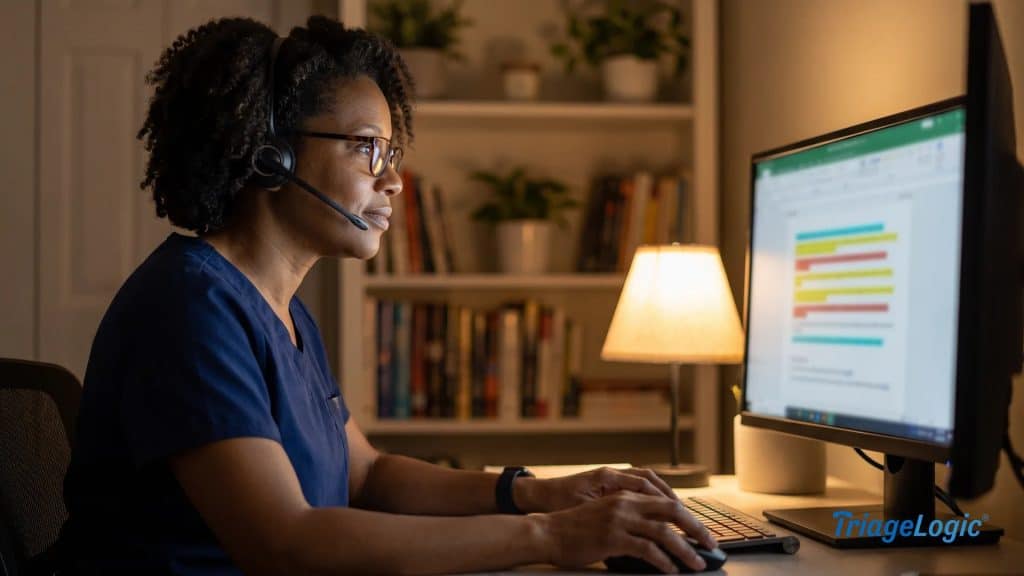
On-call nursing is not a message-taking service. A registered nurse assesses the patient’s situation in real time. The nurse follows evidence-based clinical protocols and directs the patient to the right level of care: self-care at home, a next-day appointment, urgent care, or the ER.

Our nurses return calls in about 9 minutes on average. That places us well within the URAC Health Contact Center standard of 30 minutes. Each call follows Schmitt-Thompson protocols – the physician-approved clinical decision trees used in more than 400 call centers nationwide. Brief.
Documented. Decisive.
What that looks like in practice: a caller describes chest tightness after a long flight. A message-taking service logs the complaint. The concern sits in a queue until the next business day. A nurse, working from physician-approved pathways, distinguishes between musculoskeletal discomfort and a presentation that warrants immediate evaluation.
The nurse tells the patient exactly what to do and why. No automated tool can hear hesitation in a caller’s voice. None can recognize when a patient is downplaying a symptom out of fear. Technology supports that process, but clinical judgment drives every decision.
After each call, structured documentation passes back to the practice so the care team has full context the following morning.
Every call in our on-call nursing model addresses:
- Acuity-based response – the nurse prioritizes calls by symptom severity, not queue order
- Schmitt-Thompson protocol adherence – each disposition follows a physician-approved clinical pathway, reducing variability and liability exposure
- Real-time symptom assessment – the nurse asks follow-up questions a form cannot, probing for red flags the caller may not think to mention
- Documented disposition – a record of the call, the assessment, and the recommended care level passed back to the practice
- Appropriate escalation – if a situation exceeds telephone triage scope, the nurse directs the caller to the ER or emergency services immediately
The Hidden Cost of Running On-Call Coverage In-House
Building an internal on-call RN program looks controllable until you add up overnight shift differentials, weekend premiums, and recruiting costs. This is a market where 42 of 50 states face projected nursing shortages by 2030. The math rarely lands where administrators expect.

Nurse burnout still sits at 57%, according to Nurse.org. That figure has fallen from a peak of 87% in 2021, but it remains high. On-call nursing roles concentrate precisely on the conditions that drive burnout: interrupted sleep, high-acuity uncertainty, and limited peer support at 2 a.m.
HRSA projects a national shortage of 78,610 FTE RNs in 2025. Nurses willing to take overnight call slots are already scarce and expensive. The physician side compounds the problem.
A Penn Medicine initiative covered after-hours calls at 17 primary care practices. Every physician reported that their on-call experience improved. Primary care leadership estimated a 95% reduction in clinician call volume. That outcome is hard to engineer internally without dedicated infrastructure and clinical protocols behind it.
Outsourcing converts these compounding, unpredictable costs into per-call pricing you can model. In-house coverage requires more than most administrators budget for. Here is what that actually includes:
- Recruiting nurses into overnight and weekend slots in a shrinking labor pool
- Paying shift differentials and weekend premiums that inflate per-contact costs
- Absorbing turnover costs each time a burned-out RN exits
- Maintaining clinical oversight and protocol governance to keep triage decisions defensible
- Managing physician escalation workflows without a structured clinical decision support layer
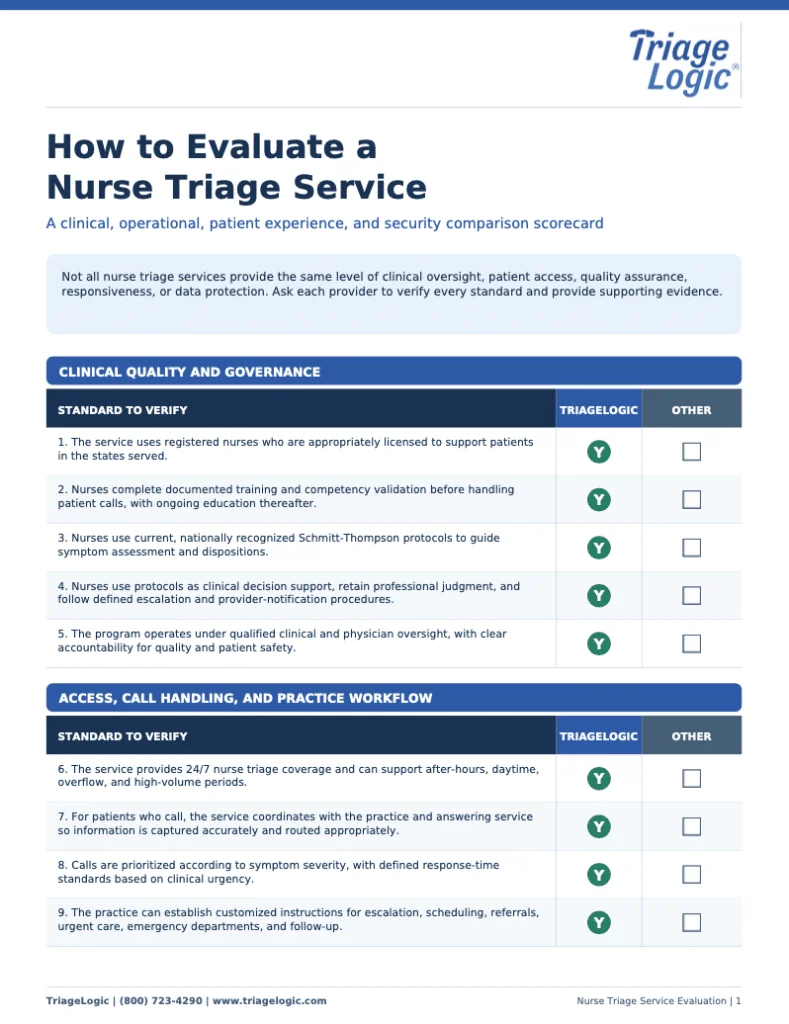
If you are weighing this build-vs.-buy decision formally, download the guide to evaluating a medical call center vendor for a structured framework to compare total cost, clinical standards, and accountability measures.
What to Demand from an On-Call Nursing Partner Before You Sign
Not every nurse triage vendor is equivalent. The standards that separate a clinically credible partner from a call-answering service are specific and verifiable. Any vendor worth considering should document all of them before a contract is signed.
Start with accreditation. URAC Health Contact Center (HCC) accreditation is the benchmark for nurse hotlines and medical triage operations. It is a distinct program from URAC’s Telehealth accreditation. A vendor holding HCC accreditation has met independently verified standards for clinical quality, staffing, and response times.
We hold this accreditation. It is one of the clearest signals you can use to distinguish a clinical partner from a basic answering service.
Clinical protocols matter just as much. Look for physician-approved Schmitt-Thompson protocols, documented call-response time benchmarks, HIPAA compliance, SOC 2 attestation, and EHR integration. On-call nursing that runs on physician-designed clinical frameworks produces materially different patient outcomes than triage guided by generic scripts.
When vetting a vendor, confirm they meet these criteria:
- URAC Health Contact Center (HCC) accreditation – this is a separate program from URAC Telehealth accreditation
- Physician-approved Schmitt-Thompson protocols governing every clinical decision
- HIPAA compliance and SOC 2 attestation for data security and privacy
- Documented response-time benchmarks with performance data, not just stated targets
- EHR/EMR integration so triage activity flows into the patient record without manual re-entry
- Physician-led network with meaningful scale to support complex calls and appropriate escalation
Our physician-led network includes more than 22,000 physicians. It covers over 42.5 million lives and has been operating since 2006.
Voice triage alone is not a complete picture. Front-desk call volume doesn’t stop at 5 p.m. It just goes unanswered. MedMessage Automate is our physician-designed digital intake tool.
It captures structured patient requests 24/7 through secure-text and digital-form pathways. Roughly 65% of routine front-desk calls shift to text, saving 3-7 minutes per message. The platform integrates with EHR systems, carries HIPAA compliance with SOC 2 Type II attestation, and is built on structured clinical guardrails – not a generic chatbot.
How Practices Are Stopping the Quiet Revenue Leak
Stanford Health Care’s dedicated clinical advice line was deployed across more than 100 specialties. It reached over one million patient encounters within four years. Less than 10% of primary care calls required escalation to a physician. That ratio reflects what well-designed triage infrastructure actually does: it routes most patients to the right answer without pulling a clinician out of their evening.
Practices that close the after-hours access gap with outsourced on-call nursing report two consistent results: fewer patients routed to outside facilities and measurably less on-call burden on clinical staff. Every unnecessary ER visit a patient avoids because a nurse answered the phone is a patient who stays inside your practice’s care model. To see how call-level clinical decisions translate into measurable patterns over time, review patient outcomes data from real nurse triage implementations.
Frequently Asked Questions
What is on-call nursing in a medical practice context?
On-call nursing refers to registered nurses who handle patient phone calls outside regular office hours. That means evenings, weekends, and holidays. These nurses assess symptoms, follow clinical protocols, and direct patients to the appropriate care setting.
How does outsourced on-call nursing reduce unnecessary ER visits?
A triage nurse uses Schmitt-Thompson or similar evidence-based protocols to evaluate symptom acuity and guide patients toward the right care level. Our data shows roughly one in six triage calls prevents a patient from making an unnecessary trip to the ER.
What accreditation should an on-call nursing service hold?
Look for URAC Health Contact Center (HCC) accreditation, which covers nurse hotlines and medical triage specifically. HIPAA compliance and SOC 2 attestation are also baseline requirements for any vendor handling protected health information.
How quickly do on-call nurses respond to patient calls?
Our nurses return calls in about 9 minutes on average. That places us well within the URAC Health Contact Center standard of 30 minutes.
What is the difference between on-call nursing and a medical answering service?
A medical answering service takes messages and routes them. It provides no clinical assessment. An on-call nurse evaluates the patient’s situation in real time, applies evidence-based protocols, and delivers a clinically grounded disposition – the difference between message-taking and actual triage.
Patients who can’t reach someone after 5 p.m. don’t wait. They call urgent care, drive to the ER, or find a provider who picks up. That decision point is where the relationship with your practice quietly frays. A URAC Health Contact Center-accredited service with licensed RNs following Schmitt-Thompson protocols closes that gap before it widens.
The Nurse Triage On Call guide walks through how the service works and what rollout looks like for practices your size. Or reach out directly to talk through your after-hours coverage needs.
Sources
- Journal of General Internal Medicine (2024)
- Hyro State of Healthcare Call Centers 2023 Report (2023)
- Hyro State of Healthcare Call Centers 2023 Report (2023)
- NCQA (2024)
- JAMA (2025)
- UnitedHealth Group (2019)
- AHRQ / HCUP Statistical Brief (2023)
- Penn Medicine News (2024)
- Nurse.org (2024)
- HRSA / National Center for Health Workforce Analysis (2022)
- URAC (2024)