
Up to 60% of all emergency room visits are non-urgent and potentially avoidable. That figure comes from the National Committee for Quality Assurance. For health plan medical directors, it surfaces directly in per-member spend and care appropriateness scores. It shows up in every contract negotiation where utilization patterns come under scrutiny.
The solution exists at the exact moment the problem forms. A member deciding right now whether to drive to the ER is reachable. A trained nurse triage service can intercept that decision. That is where nurse triage for health plans does its work.
Execution is where most plans succeed or fall short. A member who can reach a protocol-driven nurse at 11 p.m. gets a clinically sound answer fast enough to change behavior. Repeated across a population, those single interactions are where meaningful utilization shifts happen.
The Decision Moment Health Plans Keep Missing
Most avoidable ER visits are not the result of bad judgment. They happen because no accessible clinical voice was available when anxiety peaked at 10 p.m.
A member notices chest tightness after a long day. They don’t know if it’s stress, heartburn, or something worse. The ER feels like the safe choice because, at that moment, it’s the only option they can name.
What changes the outcome is a trained clinical voice available at exactly that moment. A live RN picks up on things a digital intake form cannot.
Three signals no intake form catches: the hesitation in how someone describes pain, the detail they almost didn’t mention, and the underlying fear driving the decision. Notice them, and that clinical conversation redirects a member toward urgent care. Or it reassures them they can follow up in the morning.
Research published in Health Affairs found a meaningful ER-use gap. Members with easier after-hours primary care access visited the ER at a 30.4% rate. Among those without that access, the rate climbed to 37.7%. Nurse triage for health plans works by meeting members at that decision point, before the ER becomes the default.
Learn how after-hours nurse triage captures these decision moments before members reach the ER.
What Nurse Triage Actually Does (and What It Does Not)
Nurse triage assesses symptoms using standardized clinical protocols. Done well, it is fast. A member reaches a disposition quickly. No diagnosing, no prescribing, no replacing physician care.
That boundary is not a limitation. Nurses are not trying to do what physicians do. Their role is distinct: gather a clear clinical picture, apply structured decision logic, and place a caller on the right point of the care spectrum. Getting that handoff right prevents both under-triage (missed urgency) and over-triage (unnecessary ER visits that cost everyone).
Our nurses follow Schmitt-Thompson protocols, which cover an extensive range of adult and pediatric triage topics. A protocol can flag dangerous symptom combinations. See how Schmitt-Thompson protocols guide consistent, defensible clinical decisions in practice.
No protocol, however, can catch the slight confusion in an elderly caller’s speech that signals something more serious. Clinical judgment, informed by protocol, drives the final call.
Nurse triage for health plans delivers dispositions across five levels:
- Self-care at home for minor symptoms manageable with rest or over-the-counter treatment
- Scheduled primary care appointment for issues that need a physician but are not time-sensitive
- Urgent care for same-day needs that do not require emergency resources
- ER referral reserved for symptoms meeting genuine emergency criteria, such as chest pain, stroke signs, or severe respiratory distress
- 911 activation when a caller’s condition indicates an immediate life threat
The Numbers Behind ER Diversion
The diversion impact is measurable. Roughly 1 in 6 triage calls we handle avoids an unnecessary ER visit. That ratio holds across broader published evidence as well.
The peer-reviewed case is strong. A study in the Journal of Health Economics examined triage-nurse urgent-care recommendations. Those recommendations reduced 28-day healthcare costs by $404 per patient compared with ER recommendations. A separate BMC Health Services Research study found that telephone-based nurse triage in a U.S.
HMO cut ER services by 15%.
These are not marginal gains.
The HCSC case study puts the ROI in concrete terms. Annual savings reached $12 million. Care-avoidance value per interaction came to $176, with a 3:1 return on investment overall.
Fifty-eight percent of members chose lower-acuity care instead of a planned ER visit. A trained nurse follows physician-approved Schmitt-Thompson protocols. That nurse weighs the clinical picture and recommends a safer, less costly path. A recorded menu cannot do any of that.
Review patient outcomes data that supports the diversion case to see how these figures translate across different call volumes and populations.
| Evidence Source | Key Finding | Scope |
|---|---|---|
| TriageLogic internal data | 1 in 6 triage calls avoids an unnecessary ER visit | All triage calls handled |
| Journal of Health Economics | $404 cost reduction per patient vs. ER recommendation | 28-day healthcare costs |
| BMC Health Services Research | 15% decrease in ER services after telephone triage | U.S. HMO implementation |
| HCSC case study | $12M annual savings; 3:1 ROI; 58% redirected from ER | Health plan population |
Clinical Standards That Separate a Triage Partner from a Call Center
URAC Health Contact Center (HCC) accreditation and physician-approved Schmitt-Thompson protocols are the two markers that distinguish a clinical-grade triage partner from a commodity answering service. A vendor can staff a phone line. Far fewer can demonstrate that every call is handled to a measurable, audited standard.

URAC’s HCC accreditation sets specific operational floors. These include live answer within 30 seconds on average, abandonment rates at or below 5%, and callbacks completed within 30 minutes. Our nurses average 9 minutes on callback time, well inside that standard. That gap between “acceptable” and “actual” matters when a member is deciding whether to drive to the ER at midnight.
Schmitt-Thompson protocols add the clinical layer. Developed by physicians and updated annually, they give nurses a consistent, legally defensible decision framework on every call. No script-following phone operator replicates that. Explore our Schmitt-Thompson-guided nurse triage service for health plans.
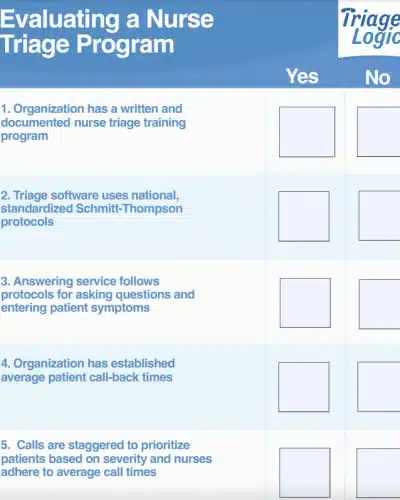
When evaluating any triage partner, health plan administrators should ask for documentation on each of the following areas:
- URAC HCC accreditation status: Request the certificate. Confirm the specific accreditation tier, not a general claim of “URAC-accredited.”
- Protocol governance: Identify who approves clinical protocols, how often they are reviewed, and whether updates are tracked.
- Callback performance data: Verify average callback time measured across all call volume, not just business hours.
- Physician oversight structure: Confirm whether clinicians actively govern nurse decisions or simply appear in the org chart.
- Scale and network depth: Our physician-led network includes more than 22,000 physicians covering over 42.5 million lives, which directly supports clinical consistency across populations.
A vendor that cannot produce clear answers to those questions is, operationally, a call center with clinical branding.
Outsourced vs. In-House: The Cost and Compliance Comparison
In-house nurse triage requires recruiting, credentialing, scheduling redundancy, and ongoing protocol governance. Outsourced models convert those unpredictable costs into a predictable per-call or monthly rate. That makes budgeting more straightforward for health plans managing variable call volumes.
The compliance burden is where the comparison sharpens. An outsourced vendor arrives with Business Associate Agreements in place, call recording security, and HIPAA safeguards already built into the infrastructure. For nurse triage for health plans, that pre-built compliance posture removes months of internal legal and IT work before a single call is answered.
Staffing continuity is the other variable that rarely appears in a straight cost comparison. After-hours workload is cited as a key burnout driver by 45% of physicians, according to the American Hospital Association. Shifting that load off internal clinical staff has real retention value, even when it doesn’t appear as a line item in the budget.
Use this framework to evaluate a nurse triage vendor against compliance and cost criteria.
| Dimension | In-House | Outsourced |
|---|---|---|
| Staffing cost | Variable; peaks unpredictably | Fixed per-call or monthly rate |
| HIPAA / SOC 2 burden | Internal team owns it | Vendor provides infrastructure |
| URAC compliance | Must build and maintain | Vendor holds accreditation |
| Scalability | Constrained by headcount | Scales with call volume |
| After-hours coverage | Strains existing clinical staff | Dedicated coverage, no staff burnout |
Capturing Member Requests Between Calls: MedMessage Automate
Not every member interaction requires a live nurse call. Structured digital intake captures routine requests accurately and routes them to the right clinical queue without adding front-desk headcount.
That is the role MedMessage Automate fills alongside a nurse triage program. It uses physician-designed secure-text and digital-form pathways to collect complete, prioritized member requests around the clock. This is not a generic chatbot pulling free-text responses into an unstructured inbox. Each pathway follows physician-built clinical guardrails, and every submission arrives with the right context for whoever handles it next.
The operational impact is concrete. Roughly 65% of routine calls shift to text. Each message handled through the system saves three to seven minutes compared to traditional phone intake. MedMessage Automate integrates with EMR and EHR systems and is HIPAA-compliant, with SOC 2 Type II attestation.
Those are not box-checking details; they are the baseline a health plan needs before any tool touches member communications.
Technology handles the structured intake. Nurses handle the clinical judgment. The two functions stay clearly separated. See how MedMessage Automate extends nurse triage coverage without adding headcount.
Frequently Asked Questions
How does nurse triage for health plans differ from a standard nurse advice line?
A nurse advice line typically answers member questions about symptoms or medications. A full nurse triage service uses structured clinical protocols, like Schmitt-Thompson, to assess urgency. It assigns a care disposition and documents the interaction. That documentation provides the compliance trail and diversion data health plans need to demonstrate program value.
What HIPAA obligations apply when a health plan partners with an outsourced triage vendor?
The vendor operates as a Business Associate and must execute a signed BAA with the health plan. The vendor is then responsible for administrative, physical, and technical safeguards on all call recordings and clinical documentation containing protected health information.
What does URAC Health Contact Center accreditation require, and why does it matter for health plans?
URAC HCC accreditation requires defined policies, 24/7 licensed RN access, established clinical guidelines, and phone performance thresholds including live answer within 30 seconds and callbacks within 30 minutes. For health plans, a URAC-accredited vendor provides documented evidence of operational and clinical standards that satisfy regulatory and audit expectations.
How quickly should a triage nurse return a member call?
URAC’s standard requires callbacks within 30 minutes. Our nurses average about 9 minutes, which matters clinically because a long wait often results in a default trip to the ER.
Can nurse triage for health plans integrate with existing EMR or care management systems?
Yes. Clinical-grade triage vendors support EMR integration. Call documentation, dispositions, and member data flow directly into existing systems. Care managers get a complete record of after-hours contacts without manual re-entry.
Closing Thoughts
Avoidable ER visits do not decline because health plans send members a wellness newsletter. They decline when a trained clinical voice is reachable at 2 a.m., guides the conversation with physician-approved Schmitt-Thompson protocols, and documents every disposition clearly.
Our URAC Health Contact Center-accredited nurse triage program was founded in 2006 and is physician-led. It serves plans covering more than 42.5 million lives. The clinical framework is built to hold up under scrutiny.
If you want to see how that model fits your plan’s structure, the Nurse Triage Protocols guide walks through the clinical and operational details in plain terms. Or contact us directly to schedule a conversation with our clinical operations team.