Incomplete patient message intake is not a volume problem. More phone lines will not fix it. Additional front-desk staff will not fix it either. It is a process-design failure.
The costs show up quietly across the workday. Nursing time drains into reconstructing vague messages. Clarification callbacks turn one patient contact into three or four separate tasks. Escalation decisions shift depending on who answered the phone.
The medical office answering service sits at the center of this problem. Patients reach practices through portal messages, voicemails, texts, and after-hours lines. Each channel feeds into an intake layer that most organizations have never formally designed. When that layer is informal, the consequences are predictable: staff workload rises, physicians get interrupted, and patients wait longer than they should.
The Real Work Starts After the Call Ends
The deeper problem is downstream rework, not call volume. TriageLogic Co-Founder and CEO Charu Raheja, PhD makes that case in our white paper on Patient Message Intake.

A patient leaves a vague message. A nurse calls back, reaches voicemail, and documents the attempt. Staff create a second message. Another team member picks it up the next morning. One contact has become three or four separate tasks, none of which appear on any dashboard.
Physicians absorb whatever incomplete context makes it through this chain. According to the American Medical Association, they now receive 57% more patient portal messages than before the pandemic.
Most practices have no minimum standard for what a message must contain before it moves forward. Without that standard, intake happens twice: first informally, by whoever first touched the contact, then again when a nurse calls back to reconstruct what the original contact missed.
The hidden cost surfaces in several ways:
- Nursing callbacks consume time gathering information that should have arrived with the original request.
- A patient misses the callback, triggering a second message and pulling in a second staff member.
- Physicians receive fragmented context rather than organized clinical summaries, prompting interruptions instead of informed decisions.
- Front-desk teams document symptoms without a clinical framework, because non-clinical operators were never expected to determine which symptom details matter medically.
- The same concern gets routed differently depending on who handled intake that day.
- Leaders have no reliable way to measure how much rework is happening.
If you want to understand how that gap compounds across a practice, read our guide on improving medical message accuracy.
Why the Operating Environment Made a Manageable Problem Worse
Four forces are widening the gap between what practices collect at first contact and what clinicians need to act. The white paper identifies each one: more channels, workforce pressure, distributed coverage, and rising patient expectations.
Patients now reach practices through telephone calls, voicemail, portals, and text messages. After-hours systems add still more entry points. Each creates another opportunity for inconsistent documentation. Consider the difference between a voicemail left at 6 pm and a structured text pathway. The voicemail often carries far less clinical detail, yet both land in the same queue expecting the same response time.
Workforce pressure narrows the margin for rework. The National Council of State Boards of Nursing reports that more than 138,000 nurses have exited the workforce since 2022, and nearly 40% of remaining nurses intend to leave by 2029. A clarification callback competes directly with clinical work that cannot wait.
As Charu Raheja, PhD puts it: “This is not simply a staffing problem or a phone-system problem. It is a process-design problem.”
These forces compound each other:
- More channels mean the same symptom may arrive through four different pathways, each documented differently.
- Workforce pressure leaves less slack for the callbacks and re-documentation that informal intake generates.
- Distributed teams lose the informal knowledge experienced staff carry. A float nurse covering an unfamiliar site applies different judgment to the same concern.
- Rising patient expectations shorten the acceptable response window. Incomplete first-contact information creates pressure faster than it used to.
Most offices can report call volume or response time. Fewer can see how many messages required clarification, whether similar symptoms were escalated consistently, or how much nursing time went toward reconstructing incomplete intake. That visibility gap is itself part of the problem.
What Incomplete Intake Costs Each Role
The burden does not fall in one place. Front-desk teams, nurses, and physicians each absorb a distinct share of the downstream work.
Front-desk staff are asked to document symptoms without a clinical framework. When information is missing, they manage repeated patient contacts: a second call, a voicemail, a portal follow-up, each adding to an already full queue. A well-run medical office answering service can absorb some after-hours volume, but if the intake structure is informal, the same rework pattern follows the message into the next day.
Nurses inherit the gap. Before any substantive clinical review can begin, they read vague messages, call patients back, ask foundational questions, and document the same concern a second time. That is preparation work, not clinical work.
Physicians feel the result as interruptions rather than organized context. Research published in Health Affairs found that top-quartile primary care physicians receive 53.3 portal messages per week, adding 2.6 hours of after-hours EHR work. The Journal of the American Medical Informatics Association found that clinicians in that group had more than six times greater odds of high exhaustion.
| Role | Primary burden | Downstream effect |
|---|---|---|
| Front-desk staff | Document symptoms without clinical framework; manage repeated contacts | Delayed routing, inconsistent documentation |
| Nurses | Review vague messages; ask foundational questions before clinical review begins | Nursing time spent on rework, not assessment |
| Physicians | Receive interruptions instead of organized context | After-hours message load; elevated burnout risk |
For a closer look at how intake quality connects to escalation consistency, see our patient symptoms and outcomes data.
What a Structured Medical Office Answering Service Actually Fixes
A medical office answering service built around clinical structure, not just call routing, addresses the process-design failure at first contact. It captures complete, prioritized information before anyone has to chase a callback or reconstruct a vague message.
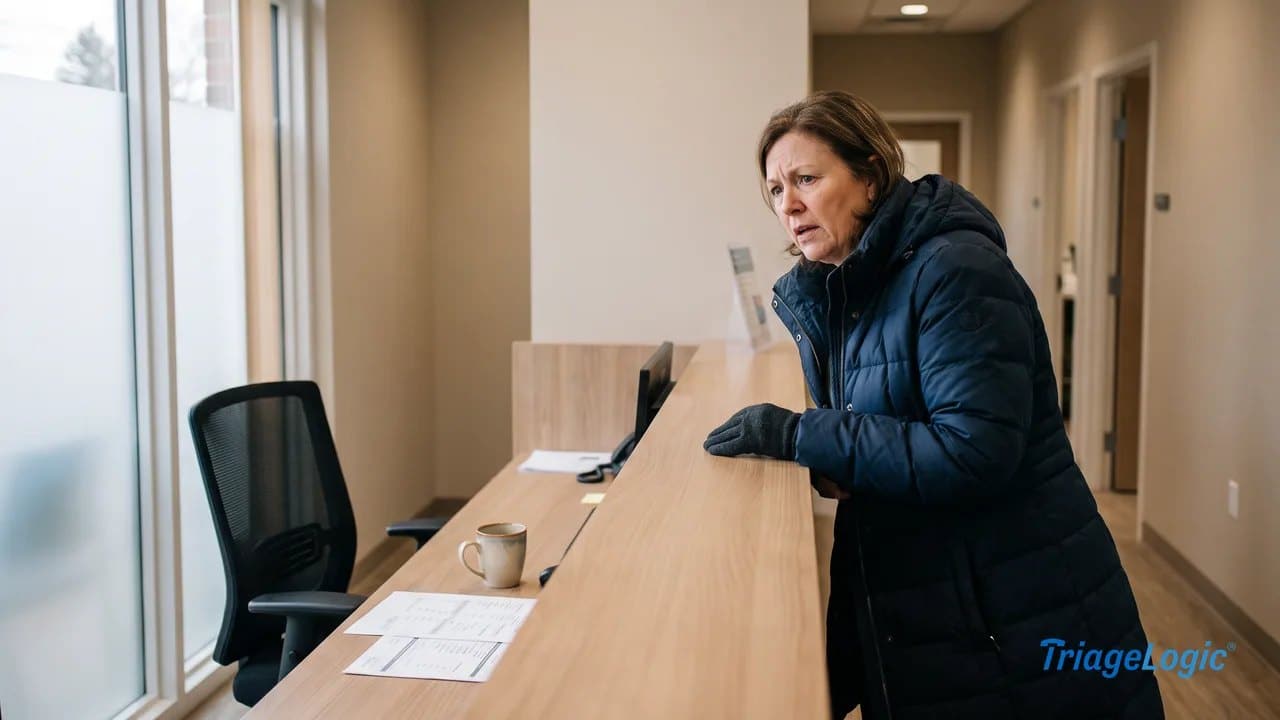
MedMessage Automate is our answer to the structured-intake gap. These are physician-designed secure digital pathways that guide patients through structured clinical questions and deliver complete, prioritized requests around the clock. Roughly 65% of routine front-desk calls shift to text. Each message saves 3 to 7 minutes of staff time. The system is HIPAA-compliant with SOC 2 Type II attestation and integrates with EMR/EHR systems.
Automated intake captures the data. A trained nurse reads the context. Technology supports the process, but clinical judgment drives every decision. AI cannot hear fear in a parent’s voice.
Our registered nurses follow physician-approved Schmitt-Thompson clinical protocols. They return calls in about 9 minutes on average, well within the URAC Health Contact Center 30-minute standard. Approximately 1 in 6 triage calls helps avoid an unnecessary ER visit.
Here is what this combination reliably delivers:
- Complete intake at first contact: Structured pathways collect clinical detail that a non-clinical operator was never trained to recognize or request.
- Consistent urgency flagging: Physician-designed guardrails route each request to the right person, removing shift-to-shift variation.
- Reduced rework across the care team: Nurses review prioritized messages instead of reconstructing incomplete ones.
- Measurable call-volume relief: Shifting the majority of routine requests to structured text frees phone lines for concerns that genuinely need a live conversation.
- Accredited clinical oversight: TriageLogic holds URAC Health Contact Center (HCC) accreditation. Founded in 2006, our network covers more than 42.5 million lives across more than 22,000 physicians.
How to Know Whether Your Practice Has a Process Problem
Most practices that have an intake problem do not know it yet. The work it creates looks like normal daily volume. Watch for three patterns: nurses spending significant time reconstructing what a patient actually meant before any clinical guidance can begin; a single patient request generating two or three contacts because the first message was incomplete; and escalation decisions that differ depending on who took the original call.
When the same symptom gets routed three different ways on three different days, the variation lives in the process, not the people.
The outcome stakes are real. Research published in Health Affairs found that patients who had less difficulty reaching a clinician after hours had ER visit rates of 30.4%, while those with access difficulty showed rates of 37.7%. A peer-reviewed after-hours nurse line study found 70% of calls resolved without physician involvement, with zero patients triaged to home care requiring a subsequent ER visit (PubMed Central).
The operational framework covering baseline measurement, minimum reliable intake standards, and the four outcome metrics that reveal whether intake is actually working is detailed in our Patient Message Intake white paper. If after-hours coverage is a pressure point, download the Nurse Triage On Call guide as a companion starting point.
Frequently Asked Questions
What is a medical office answering service and how does it differ from a general answering service?
A medical office answering service uses clinical staff, typically registered nurses following approved protocols, to assess patient urgency, document symptoms, and route calls appropriately. A general answering service takes messages without clinical judgment, which can miss escalation signals and create the exact incomplete-intake problem our white paper describes.
Why is incomplete patient message intake a clinical risk, not just an administrative inconvenience?
When a nurse or physician receives a message without timing, severity, or relevant medical history, they must either act on insufficient information or spend clinical time recovering it. Both outcomes carry risk: a missed escalation or a delayed response can affect patient outcomes, as our Patient Message Intake white paper documents.
What standards should a medical office answering service meet?
Look for URAC Health Contact Center (HCC) accreditation. It sets measurable thresholds for nurse qualifications, answer times, and callback windows. HIPAA compliance and a signed Business Associate Agreement are baseline requirements. Schmitt-Thompson clinical protocols are the recognized evidence-based standard for telephone triage decisions.
How does automated message intake fit alongside nurse triage?
MedMessage Automate captures structured clinical information at first contact 24/7 through physician-designed secure-text and digital-form pathways, so when a nurse reviews or responds, the foundational detail is already there. It reduces rework; it does not reduce the nurse’s role.
How can a practice measure whether its current intake process is causing downstream waste?
Start with three numbers. Track the share of messages that require at least one clarification callback. Measure the average nursing minutes spent per message before clinical review begins. Then check whether escalation decisions are consistent across staff.
Our Patient Message Intake white paper provides a baseline measurement framework for exactly these metrics.
Closing Thoughts
Most practices already sense that message intake is where the process breaks down. The white paper by Charu Raheja, PhD gives you a precise framework for naming it, shows where variation enters and where rework accumulates, and defines what a dependable intake system needs to do.
Our nurses follow physician-approved Schmitt-Thompson protocols. Our structured intake tools are built to the same clinical standard. Together, they address both the after-hours triage call and the message that arrives before any nurse is ever involved. Start with the Patient Message Intake white paper to work through the foundational questions and build the case internally.
When you are ready to see how structured intake and nurse triage fit your practice specifically, reach out to our team. We can walk through what a better-designed process looks like for your patient volume and coverage model.
Sources
- TriageLogic white paper: Patient Message Intake
- American Medical Association (2023)
- Health Affairs (2026)
- Journal of the American Medical Informatics Association (2026)
- American Medical Association (2026)
- American Hospital Association (2024)
- National Council of State Boards of Nursing (2025)
- Health Affairs (2013)
- PubMed Central (2025)
- Agency for Healthcare Research and Quality (2010)
- PubMed (2026)
- URAC