
Phone Triage Software: How Automated Call Routing Ends the Inbound Patient Chaos
By TriageLogic
Most practices do not realize their routing is broken until a nurse spends half her shift on refill requests. Meanwhile, a patient with worsening symptoms sits on hold. Phone triage software solves that problem directly. It separates calls that need a nurse from calls that do not, before anyone picks up the phone.
The daily reality in most small and mid-size practices is a single undifferentiated queue. Refill requests, billing questions, lab follow-ups, and genuinely urgent symptom calls all arrive together. Routing logic is the fix. It reads caller intent at the start of the interaction and sends clinical calls to clinical staff.
Everything else moves to the right channel automatically. No manual sorting required.
What Phone Triage Software Actually Routes
Phone triage software categorizes inbound patient calls by type and urgency. Each call routes to the correct destination. It does not replace clinical judgment for symptom calls. What it does is protect clinical staff from every call that does not require clinical judgment.
The common misconception is that phone triage software is just a fancier IVR phone tree. It is not. A traditional IVR offers numbered menu options and dumps unresolved calls back to the front desk.
Our MedMessage Automate product works differently. It routes patient requests through physician-designed, structured pathways. Those pathways capture complete clinical context before a message ever reaches staff. That is a materially different mechanism, built around clinical guardrails rather than button presses.
What well-designed phone triage software handles automatically, and what it passes to a nurse:
- Appointment scheduling and cancellations – routed to scheduling without staff involvement
- Billing and insurance questions – queued to the appropriate administrative staff, not a clinical line
- Prescription refill requests – captured with structured intake fields and sent to the prescribing provider
- General information requests – office hours, directions, portal access
- Symptom and urgent-care calls – these pass to a licensed nurse; software captures the reason for the call, but clinical judgment drives what happens next
The Call Volume Math That Makes Manual Sorting Unsustainable
When front-desk staff manually sort every inbound call, roughly 65% of those calls are routine requests that could be resolved without a live agent. That backlog extends hold times for every caller, including the ones who actually need a nurse.
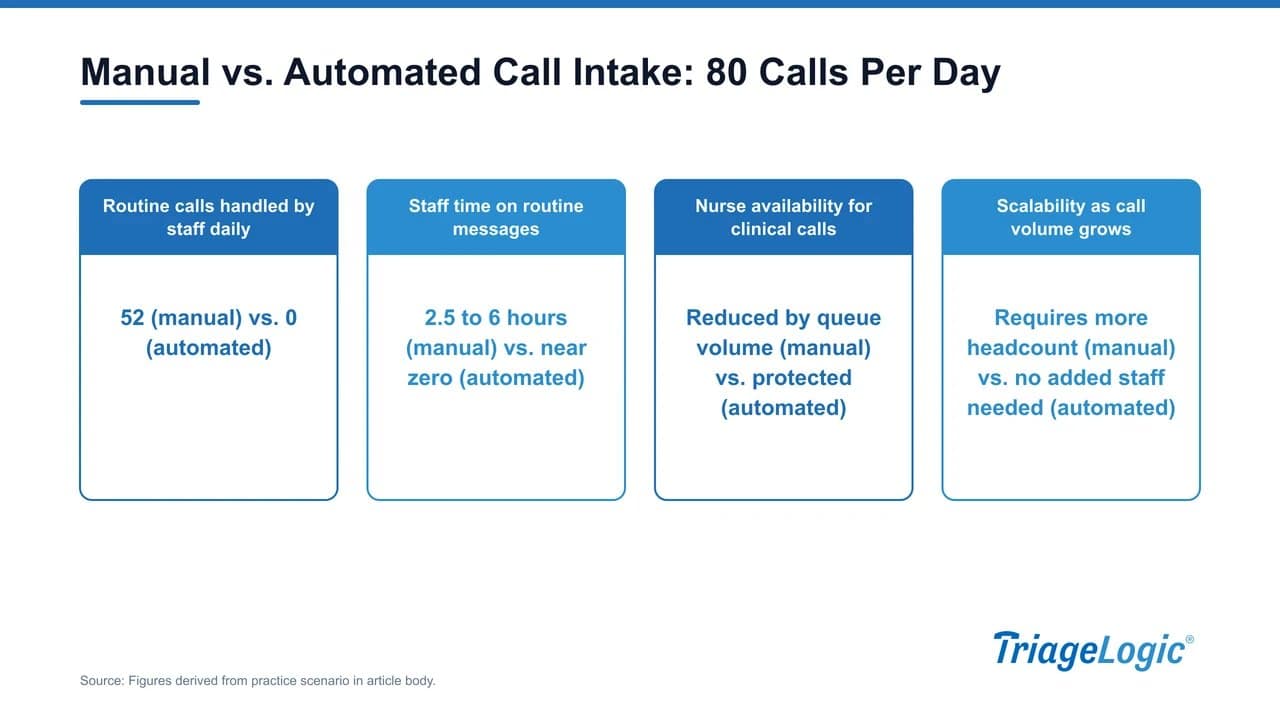
Consider a practice that takes 80 calls per day. Sixty-five percent of those are routine. That is 52 calls absorbed by staff daily. At 3 to 7 minutes per message, staff spend between two and a half and six hours on work that never required a clinical decision.
Meanwhile, the calls that do require phone triage sit in the same queue.
Research reinforces this picture. A systematic review published in PubMed Central found that phone consultation alone resolved at least 50% of calls. The provider was never needed. A well-structured intake process that captures routine patient requests without front-desk involvement does not just reduce noise.
It frees clinical staff for the calls where judgment actually matters.
| Scenario | Manual Intake | Automated Intake |
|---|---|---|
| Routine calls per day (80 total) | 52 handled by staff | 52 shifted to structured digital pathways |
| Staff time on routine messages | 2.5 to 6 hours daily | Near zero |
| Nurse availability for clinical calls | Reduced by queue volume | Protected |
| Scalability as call volume grows | Requires more headcount | Handles increased volume without added staff |
How Automated Routing Works: From Incoming Call to Correct Destination
When a patient calls or texts, MedMessage Automate captures their request through physician-designed digital pathways. The system then applies structured clinical guardrails to prioritize urgency. Each request routes to the correct destination without a staff member manually reading or sorting it.
The intake flow matters more than most practices realize. A generic symptom-checker app asks open-ended questions and collects whatever the patient types. That is a different process entirely. Our physician-designed intake forms guide the caller through a defined sequence of fields.
The output is always a structured, prioritized record, never a free-text note that someone still has to interpret.
Once the request is captured, urgency logic takes over. A refill request routes to the front desk. A worsening symptom flags as clinical and moves to the nurse queue. No one has to read five messages and guess.
Two compliance baselines are non-negotiable for any vendor you evaluate: HIPAA compliance and SOC 2 Type II attestation. MedMessage Automate meets both. EMR/EHR integration matters equally. Without it, staff re-enter data by hand and the efficiency gains disappear.
To see how the intake pathways are built, download the MedMessage Automate overview.
Key capabilities the flow delivers:
- Capturing complete patient request details before any staff member is involved
- Applying clinical guardrails that separate urgent from routine without human sorting
- Routing administrative requests away from the clinical queue automatically
- Flagging requests that require nurse review based on symptom indicators built into the pathway
- Integrating directly with your EMR/EHR so routed messages appear where staff already work, with no double-entry
When the Call Is Clinical: What Happens After Routing
Automated routing is only as valuable as what happens when it correctly escalates a symptom call. Response speed matters. So does protocol quality. Both shape patient safety and ER diversion outcomes.
Speed matters more than most administrators expect. Our nurses average about 9 minutes per callback. That comfortably meets the URAC standard requiring callbacks within 30 mins for health contact centers. Consider a parent who is unsure whether a child’s symptoms warrant a late-night ER visit.
Without a callback, that parent often drives in anyway. That gap between “connected” and “waiting until morning” is where outcomes diverge.
Every phone triage encounter follows Schmitt-Thompson clinical protocols. These physician-approved decision frameworks define how urgency is assessed. They also define what guidance a nurse can safely give. A 2023 PubMed study found that non-clinician primary triage misses key symptoms requiring immediate care.
The same study found it is also too risk-averse for most calls. Trained nurses following structured protocols do not have that problem.
The results are measurable. Approximately 1 in 6 of our triage calls helps a patient avoid an unnecessary ER visit. According to HFMA, preventable ER spending totals an estimated $8.3 billion annually. That diversion is a meaningful contribution to bending that curve.
The credibility behind those outcomes is not incidental. We have held URAC accreditation since 2014. URAC Health Contact Center (HCC) is a distinct program from URAC Telehealth accreditation. It sets the standard specifically for clinical contact center services, including nurse triage.
For organizations evaluating whether to pair automated message routing with a clinical safety net, see how Schmitt-Thompson-based nurse triage works as the clinical layer behind automated routing.
Three Routing Mistakes That Add Cost
Most routing failures share a common structure: the wrong call type reaches the wrong person. The practice pays in staff time, patient wait time, or a clinical incident a protocol would have caught.
The most consequential mistake is routing symptom calls to front-desk staff. Non-clinical operators cannot apply Schmitt-Thompson protocols. They carry no licensure to back their advice and cannot document clinical reasoning. The result is both a liability exposure and a documented source of clinical error.
The second failure mode is prescription refill requests landing in a nurse’s queue. Refill routing is fixable. Phone triage nurses are licensed clinicians whose time carries real cost. Routing routine refill calls through structured intake pathways, rather than a clinical line, burns that capacity on administrative work.
The third failure drives burnout as much as it drives cost: after-hours calls routed to on-call physicians when nurse-level triage would have resolved them. A PubMed Central study found that an after-hours nurse line handled 70% of calls without physician involvement. No patients triaged to home care in that study subsequently required an emergency room visit or hospitalization. Misrouting those calls to physicians is not a minor inefficiency.
What each failure costs in practice:
- Symptom calls to front-desk staff: documented clinical errors, liability exposure, and potential escalation to a serious incident a protocol would have prevented
- After-hours calls to on-call physicians: unnecessary middle-of-the-night interruptions, accelerated provider burnout, and physician time spent on calls a nurse could safely handle
- No acuity-based callback queue: lower-urgency calls displace higher-acuity ones when staff sort by arrival order rather than clinical need
- Calls resolved sometimes as late as the next day: when after-hours messages pile up unstructured, morning staff inherit an unsorted queue and patients wait hours for answers they needed overnight
If you are auditing your own routing workflows, use this evaluation checklist when comparing call-routing vendors to identify exactly where your current setup creates gaps.
Scaling Coverage Without Scaling Headcount
Call volume grows with patient panel size, but staff hours in a day do not. Automated routing decouples those two curves.
Consider a practice handling 300 calls per day with no routing layer. Every call lands at a human decision point. MedMessage Automate shifts roughly 65% of routine front-desk calls to structured text-based intake. That means approximately 195 daily interactions move through physician-designed digital pathways before a staff member touches them.
At 3 to 7 minutes saved per message, the practice recovers between 10 and 23 hours of staff time every day.
The after-hours gap is where automated intake earns its keep most clearly. Practices without 24/7 phone triage coverage face a hard choice. They can leave patients without a response until morning. Or they can ask clinical staff to absorb late calls on top of a full daytime load.
That second option is a documented burnout driver. After adjusting for demographic and work factors, physicians are 82.3% more likely to experience burnout than workers in other occupations, according to Stanford Medicine. Removing after-hours call burden without adding headcount is one of the few levers that actually changes that equation.
The clinical backstop behind this routing is not lightweight. Our physician-led network covers more than 42.5 million lives and includes more than 22,000 physicians. Automated intake feeds into genuine clinical depth when escalation is needed. Download the Nurse Triage On Call guide to understand how after-hours clinical coverage works alongside automated routing.
Frequently Asked Questions
What is the difference between phone triage software and a traditional IVR phone tree?
A traditional IVR routes calls based on button presses. Phone triage software uses physician-designed intake pathways that capture complete, structured clinical information before routing. The receiving staff or nurse gets a prioritized, categorized request rather than a raw call.
Does automated phone triage replace triage nurses?
No. It removes administrative and routine calls from nurses’ queues so nurses handle only clinical calls. For symptom calls that require assessment, a licensed RN following Schmitt-Thompson protocols still drives the decision.
What compliance standards should a phone triage routing system meet?
At minimum, look for HIPAA compliance and SOC 2 Type II attestation on the software side. For the clinical nurse triage layer, URAC Health Contact Center (HCC) accreditation is the established standard for clinical contact center services.
How quickly should a nurse respond after an automated system escalates a clinical call?
URAC standards require callbacks within 30 minutes on average. Our nurses average roughly half that time, consistently meeting the benchmark with room to spare.
Can automated phone triage integrate with our existing EHR?
Yes. MedMessage Automate is built to integrate with standard EMR/EHR platforms so routed messages and intake data flow directly into existing records without manual re-entry.
Closing Thoughts
Phone triage works best when clinical judgment and administrative volume never compete for the same bandwidth. That is not just a design preference. Automated message intake handles the routing problem. Nurses following physician-approved Schmitt-Thompson protocols handle the judgment problem.
That division is a patient safety choice as much as an efficiency one.
If your call volume has grown past what front-desk staff can sort in real time, MedMessage Automate is a practical starting point. Or contact TriageLogic directly to walk through what routing logic would look like for your practice size and call mix. If your team is still fielding a high share of respiratory and illness-related calls, our guide to nurse triage for COVID-19 patient calls offers protocol-grounded guidance. Put it to use right away.