How to Triage Nurses Evaluate Patient Symptoms?
Having a standardized system to evaluate symptoms is also a huge advantage for any nurse team. The triage protocols developed by Drs. Barton Schmitt and David Thompson are considered the gold standard in this industry, and with good reason: they ask the appropriate questions to determine how severe each patient’s symptoms are, accounting for all potential health factors. This keeps triage nurses focused on a linear progression of steps, avoids any overlooked symptoms that patients may have failed to mention, and keeps nurses within their scope of practice.
As a result, Nurse Triage On Call is a powerful way to reduce a health system’s liability while simultaneously improving patient health outcomes and boosting revenue.
Improved Outcomes and Cost Savings:
Preventing unnecessary ER admissions has also been an important driver for ensuring patients have access to healthcare professionals who can assess their symptoms and determine the level of care needed to address their symptoms. A report from the Health Care Cost Institute found that on average an emergency room visit costs about $2,000. Fortunately, a telephone nurse triage service can be used as an important tool for hospitals to combat unnecessary patient admissions.
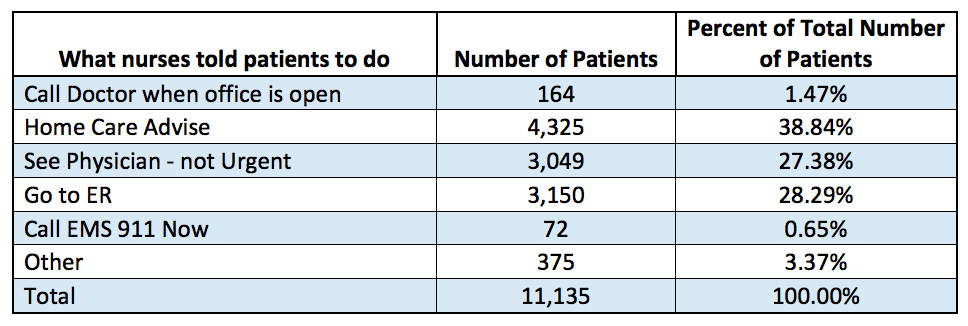
We review data from 11,135 patients planning to go to the ER before speaking to the a triage nurse. We then compare to what they were actually told to do (that is, what was their final disposition given by the nurse). The figure below describes the results from patients who answered that they would “go to the emergency room.”
Figure . What was the disposition determined by the triage nurses for the patients who answered that they would “go to the ER”?